
How to wash your baby's clothes: a practical guide
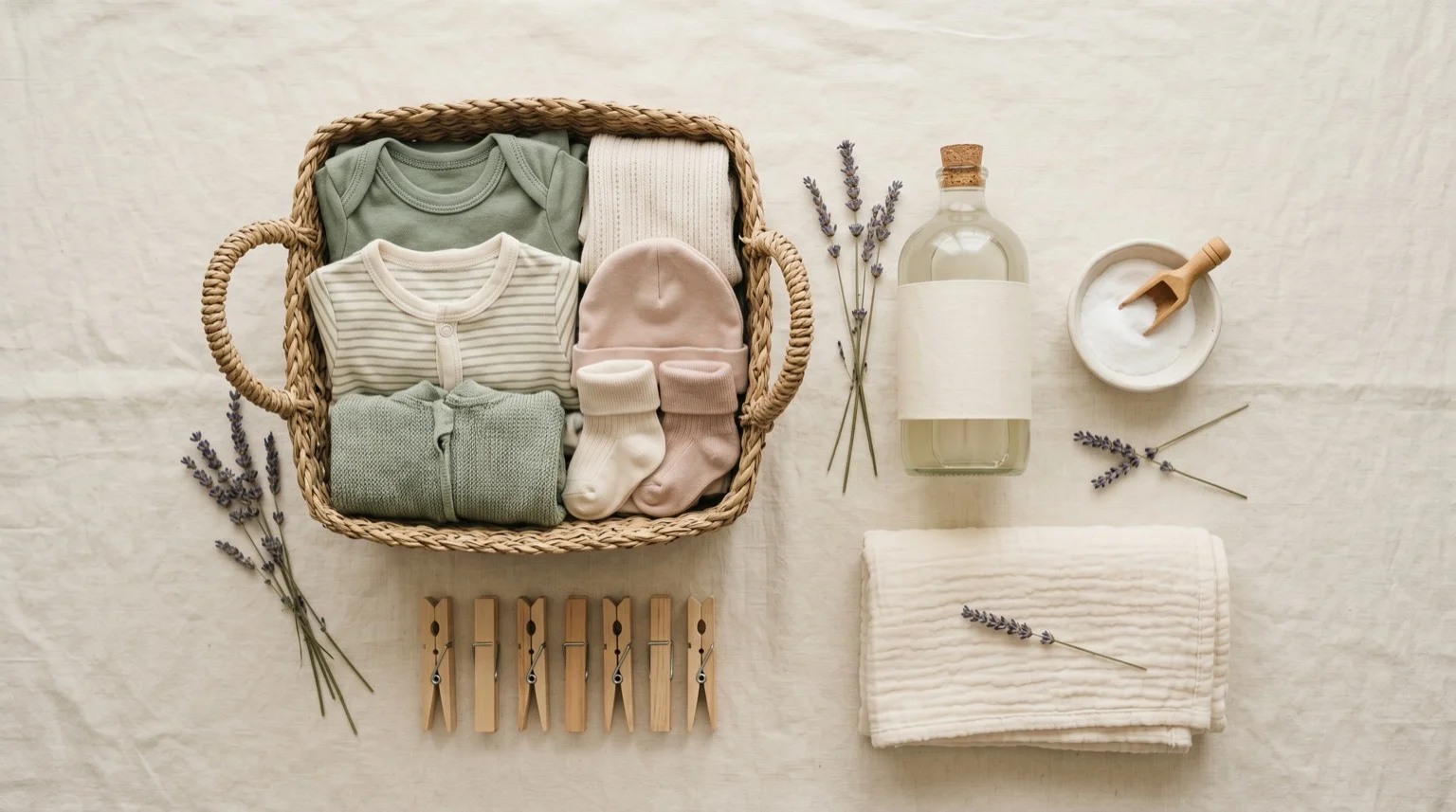
A baby's skin is thinner than an adult's — in babies aged 3 to 24 months the outermost layer measured about 30% thinner — and whatever stays in the fabric sits against it for hours: detergent residue, scented fabric softeners, harsh bleaches. Nationwide Children's Hospital lists soaps and detergents among the most common irritants that cause contact dermatitis in children. That's why washing your baby's clothes isn't like doing the regular laundry. Two rules guide everything: always follow the care label and use gentle detergents. Here's how to put them into practice, step by step.
1. The first wash: always, before wearing the garment
Even new clothes, even certified ones, should be washed before their first use. During manufacturing, transport and display in the store, fabrics build up sizing agents, dust, processing residue and traces of substances used to keep them “in shape”. A first wash removes them and softens the fibres.
This applies to bodysuits, onesies, sheets, towels, hats — anything that will come into contact with the skin. The only exceptions are outerwear that doesn't touch the skin (jackets, heavy snowsuits), for which an initial wash is still recommended but less urgent. Do it a few weeks before your due date, so the outfits going into your hospital bag are ready.
2. Read the care label: the symbols that matter
The care label is the garment's official guide (for the fabric composition part, see how to read baby clothes labels). For newborn laundry, focus on three pieces of information:
- Wash temperature. US labels state it in words — cold, warm, hot — or with the ASTM care symbols the FTC allows in place of words. Under the FTC Care Labeling Rule, cold means up to 86 °F, warm 87-111 °F and hot 112-145 °F, and “Machine wash” with no temperature means hot water up to 145 °F will not harm the garment. If the label says cold, don't go warmer or you'll ruin the garment.
- Bleaching. The label says “No bleach” or “Only non-chlorine bleach, when needed”; if it says nothing about bleach, any bleach is safe for the fabric. Chlorine bleach has no place on newborn clothes in any case.
- Drying and ironing. The square indicates the tumble dryer (inner circle) and the iron indicates the ironing temperature. Many technical or stretch fabrics shouldn't go in the dryer at high temperatures.
Golden rule: when in doubt, always choose the gentlest treatment indicated. Better a garment washed at a lower temperature than a ruined fabric.
3. Choose a gentle detergent
This is the most important point. The right detergent for a newborn must be gentle, free of strong fragrances and easy to rinse out. Look for these features:
- A formula specifically for newborns or sensitive skin, dermatologically tested and hypoallergenic. Search for newborn detergents on Amazon
- No intense fragrances, no dyes and no optical brighteners.
- Fragrance-free rather than “lightly scented”: fragrance is an ingredient like any other.
- Liquid is better than powder: it dissolves completely and leaves less residue in the fabric.
Use less than you think: too much detergent is one of the main causes of residue on the skin. For a small, lightly soiled load, use the smallest dose the detergent's instructions give.
4. Fabric softener and fragrances: better to avoid them
Fabric softener leaves a film on the fabric that reduces breathability and can irritate. For the first few months it's best to avoid it altogether. If you want softer garments, use half a cup of white vinegar in the fabric softener compartment: it softens naturally, neutralises odours and helps dissolve detergent residue (the vinegar smell disappears completely during drying).
5. The extra rinse: the secret against irritation
If your washing machine allows it, set an extra rinse. It's the most effective way to remove every trace of detergent from the fabric — far more important than the type of detergent itself. A well-rinsed garment washed with a regular detergent is safer than a poorly rinsed garment washed with a “bio” detergent.
6. Wash baby clothes separately (at least at the start)
In the first few months it's best to wash the baby's clothes separately from the adults' laundry. It reduces the transfer of scented detergent residue, fabric softeners, pet hair and tougher dirt. After the first months, if the baby has no eczema or other skin problems, you can gradually combine the loads.
7. Tackling the most common baby stains
Milk, spit-up, baby food, poo: newborn laundry is a daily challenge. How to deal with stains without harsh products:
- Milk and spit-up: rinse immediately with cold water (never hot: heat sets the proteins). Then pre-treat with a gentle bar soap or a little baby detergent rubbed in by hand.
- Poo: remove the bulk, rinse in cold water, pre-treat with a gentle bar soap. For stubborn stains, leave the garment in the sun: it's a very powerful and safe natural bleach.
- Baby food (carrots, fruit): cold water + a baking soda paste on the stain, then a normal wash.
- Avoid generic adult spray stain removers: often too harsh. There are pre-treatments specifically for newborns. Search for gentle baby stain removers
8. Drying baby clothes
- Air-dry, ideally in the sun. The sun dries, sanitises and bleaches naturally. Perfect especially for white bodysuits and stained cloths.
- Tumble dryer: convenient, but check the care label. Use gentle low-temperature programmes; high temperatures shrink cotton and ruin the elastic.
- No damp garments in the wardrobe. Residual moisture encourages mould and bad odours: make sure they're perfectly dry before storing them.
Quick newborn laundry checklist
- ✅ First wash before using any new garment.
- ✅ Always follow the care label symbols (temperature, bleaching, drying).
- ✅ Gentle detergent, reduced dose, no fabric softener.
- ✅ Extra rinse to remove residue.
- ✅ Separate laundry in the first few months.
- ✅ Stains: cold water right away, gentle bar soap, sun.
Washing baby clothes in short
Washing your baby's clothes is simple if you follow two principles: respect the care label and use gentle, well-rinsed products. Always do the first wash, use a specific detergent in a reduced dose, no fabric softener, an extra rinse and — whenever you can — the sun as a natural ally. These are small precautions that protect your baby's skin and make their clothes last longer. Laundry is half the job: for cleansers, creams and wipes, see our guide to newborn skincare products.
Frequently asked questions about washing baby clothes
Why does newborn laundry need different care than regular laundry?
Because a baby's skin is thinner than an adult's — the outermost layer measured about 30% thinner in babies aged 3 to 24 months — and whatever stays in the fabric sits against it for hours. Nationwide Children's Hospital lists soaps and detergents among the most common irritants that cause contact dermatitis in children. That's why two rules guide everything: always follow the care label and use gentle detergents.
Should new clothes be washed before the baby wears them?
Yes, always, even if they're new and certified. During manufacturing, transport and display in the store, fabrics build up sizing agents, dust and processing residue. This applies to bodysuits, onesies, sheets, towels and hats; the only exceptions are outerwear that doesn't touch the skin, such as jackets and heavy snowsuits.
What temperature should you wash newborn clothes at?
The one the care label allows. On US labels, the FTC Care Labeling Rule defines cold as up to 86 °F, warm as 87-111 °F and hot as 112-145 °F, and a label that just says “Machine wash” means hot water up to 145 °F will not harm the garment. If the label says cold, don't go warmer.
Is fabric softener okay for newborn laundry?
It's best to avoid it altogether for the first few months, since it leaves a film on fabric that reduces breathability and can irritate the skin. For softer garments, use half a cup of white vinegar in the fabric softener compartment instead — it softens naturally and helps dissolve detergent residue, and its smell disappears completely during drying.
Is it worth washing newborn clothes separately from the rest of the laundry?
Yes, at least for the first few months: it reduces the transfer of scented detergent residue, fabric softeners, pet hair and tougher dirt. After the first months, if the baby has no skin problems, you can gradually combine the loads.
How do you remove milk or spit-up stains without damaging the garment?
Rinse immediately with cold water, never hot, because heat sets the milk proteins. Then pre-treat by rubbing in a gentle bar soap or a little baby detergent by hand.
Sources
- Stamatas GN, Nikolovski J, Luedtke MA, Kollias N, Wiegand BC — Infant skin microstructure assessed in vivo differs from adult skin in organization and at the cellular level, Pediatric Dermatology 27(2), March–April 2010 (accessed September 26, 2026). Source for: the stratum corneum about 30% thinner than in adults, measured in babies aged 3 to 24 months.
- Nationwide Children's Hospital (medical reviewers Chelsey Schilling, Dan Brennan, Daphne Pierce-Smith) — Contact Dermatitis in Children (last reviewed August 1, 2025; accessed September 26, 2026). Source for: soaps and detergents among the most common irritants.
- Federal Trade Commission — Clothes Captioning: Complying with the Care Labeling Rule and 16 CFR part 423 (accessed September 26, 2026). Source for: ASTM care symbols in place of words, bleach instructions, the cold, warm and hot temperature ranges and the meaning of “Machine wash”.