
Baby clothes labels: how to read fabric composition
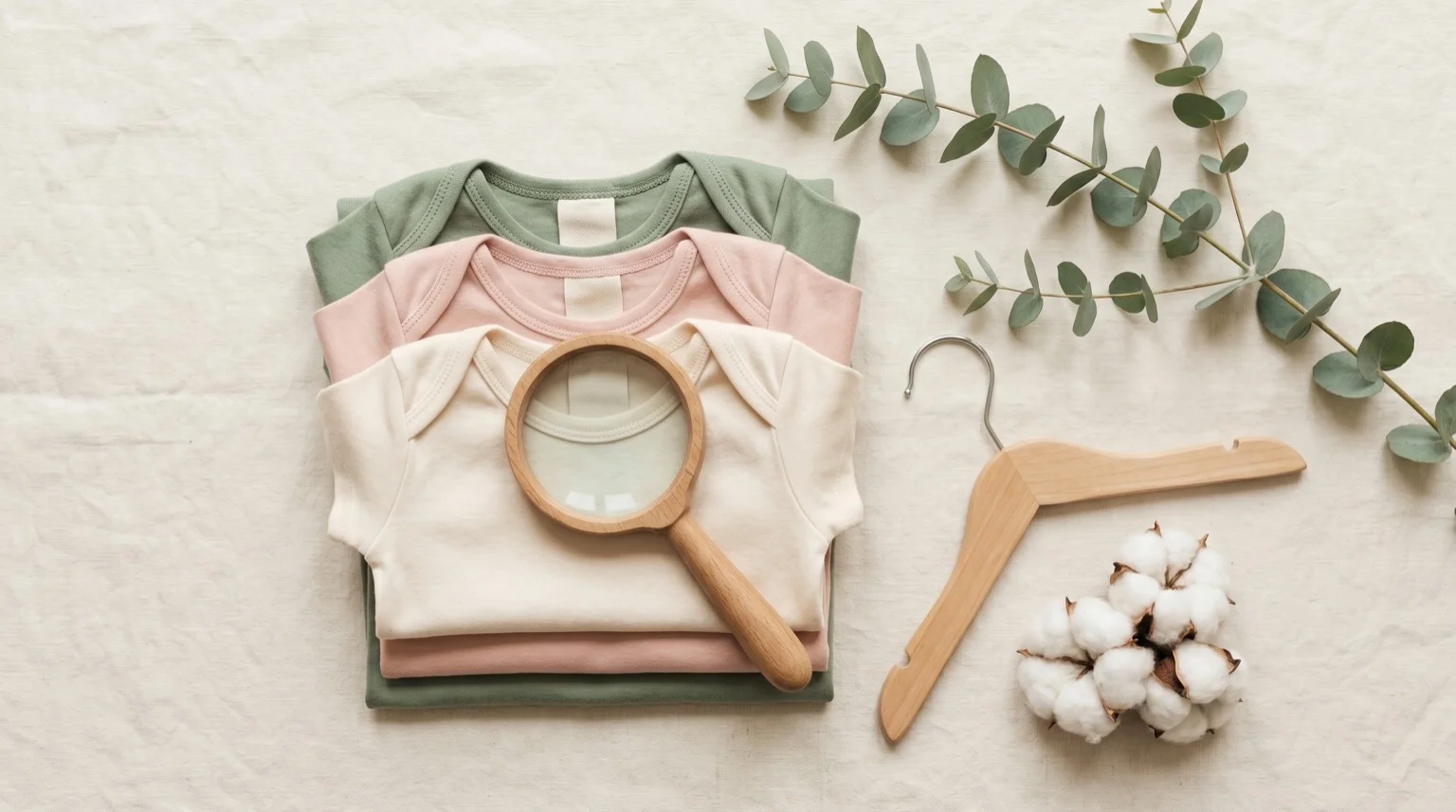
When you choose clothing for your baby, the real clue to quality isn't the price or the brand: it's the label. That little strip of fabric sewn onto the side or the collar holds all the information that truly matters — composition, origin, certifications, washing instructions. Learning to read it in 30 seconds spares you bad purchases and protects your newborn's delicate skin.
Why the label matters so much for a newborn
A newborn's skin is about 5 times thinner than an adult's, more permeable and with a protective barrier that is still immature. This means everything that touches the skin — fibres, dyes, processing residues — comes into contact with a far more reactive skin tissue. A garment with the wrong composition or treated with harsh substances can trigger irritation, redness, eczema.
The label is also the only thing on the garment that federal law forces the seller to get right. Under the Textile Fiber Products Identification Act the FTC requires the generic fibre names and percentages by weight in descending order, the country where the product was processed or manufactured, and the maker's business name or RN number. A separate FTC rule, the Care Labeling Rule (16 CFR 423), requires care instructions on a label attached permanently and securely and legible for the useful life of the garment. Knowing how to read all of that is the first form of prevention.
1. Composition: which fibres to look for (and which to avoid)
This is the most important piece of information. Composition is expressed in fibre percentages. For the first months, aim for natural, breathable and soft fabrics.
Recommended fibres for a newborn
- 100% cotton — the king of baby clothing. Breathable, soft, it absorbs sweat and doesn't irritate. Even better if it's “organic cotton”, grown without pesticides and processed without harsh substances.
- Certified organic cotton — the best for sensitive skin. Look for the GOTS wording (see below).
- Merino wool — for the cold months: temperature-regulating, breathable, it doesn't itch like traditional wool. Pricey but excellent for winter bodysuits and sleepsuits.
- Bamboo (bamboo viscose) — very soft and breathable, often used in a blend with cotton. Great if you're after lightness.
- Linen — cool and breathable for summer, even if a bit stiffer: better in a blend with cotton.
Fibres to limit or avoid in direct contact with the skin
- Polyester, acrylic, nylon (100%) — synthetic fibres that breathe poorly, trap sweat and static electricity. A small percentage (5-10% elastane/spandex) to add stretch to cuffs is perfectly fine; a polyester bodysuit is not.
- Blended fabrics with >30% synthetic in direct contact with the skin, especially in summer: the baby sweats and gets irritated more easily.
Rule of thumb: for garments in direct contact with the skin (bodysuits, sleepsuits, pyjamas) aim for at least 90% cotton. For outer layers (jackets, snowsuits, coats) composition matters less, because they don't touch the skin.
2. Country of origin: what the “Made in” really tells you
The “Made in” is the line shoppers read first and over-interpret most. In the US it carries less weight than people assume, for a simple reason: federal children's-product rules attach to what is sold here, not to where it was sewn.
- The chemical limits are the same either way. A children's garment offered for sale in the US has to meet the CPSIA limits on lead and phthalates, and the CPSC flammability standards for children's sleepwear (16 CFR 1615 for sizes 0–6X, 1616 for sizes 7–14), whether it was made in North Carolina, Portugal or Bangladesh. Importers carry the same certification duty as domestic manufacturers.
- What origin does tell you is something about supply-chain length and traceability, and sometimes about a brand's ability to audit its own factories. It tells you nothing about the dyes actually used on the garment in your hand.
- Where origin is genuinely useful is as a cross-check on the rest of the label: a garment whose origin, fibre percentages and RN number are all clearly declared is from a seller taking the FTC rules seriously. Vague labelling is the warning sign, not a particular country.
In practice: a “Made in Italy” garment with no certifications versus a “Made in Bangladesh” one with GOTS certification — the second gives more guarantees on chemical safety. Read the certification, not the flag.
3. The certifications that matter
They are the most reliable way to know a garment has been tested for safety. Look for these marks on the label or on the tag:
- OEKO-TEX® Standard 100 — the most widespread certification. It guarantees the fabric has been tested for over 100 harmful substances. For newborns there is “Class I” (products for children up to 3 years), the strictest of all.
- GOTS (Global Organic Textile Standard) — certifies that the fibre is organic and that the entire supply chain (dyeing, finishing) meets stringent environmental and toxicological criteria. The best for organic cotton and wool.
- Made in Green by OEKO-TEX® — combines chemical safety and sustainable, traceable production.
If a garment carries OEKO-TEX Class I or GOTS, you can buy it with your eyes closed when it comes to skin safety.
4. Care instructions: small but decisive
One thing to know before you squint at a pictogram: US care labels are usually written in words. The FTC rule lets a manufacturer use the ASTM D5489 care symbols in place of words, but the ISO symbols used on European labels are not currently permitted here, so the symbol set you may have seen abroad is not the one you will find in a US store. For baby clothing, two rules above all:
- “Machine wash warm” or hotter — a newborn's garments are worth washing at a medium-high temperature (warm is roughly 105 °F, hot roughly 130 °F) to clear bacteria and residues. Check that the garment can take it: a label that says cold wash only, or hand wash, is less practical in real life with a newborn, whatever the fabric is.
- “Only non-chlorine bleach, when needed” or “No bleach” — the rule only requires a bleach instruction when some bleaches would damage the garment, so the presence of that line is itself information. Chlorine bleach is the wrong tool on baby clothes in any case.
Important: always wash new garments before first use, even certified ones. It removes processing residues, sizing and dust caused by transport and store display.
5. Construction details to check on the label and on the garment
- Flat, soft seams — stiff seams rub. Quality garments have flat seams, especially on shoulders and crotch.
- Printed label, not sewn — more and more brands print the information directly onto the inner fabric, to avoid the annoying rubbing of the label on the back of the neck. A nice sign of attention to detail.
- Sturdy, well-attached snaps — tug them. A snap that pulls off is a small part, and small parts are a choking hazard in anything intended for a child under 3.
- No hood or neck drawstrings — the CPSC has determined that hood and neck drawstrings on children's upper outerwear in sizes 2T to 12 are a strangulation hazard and a substantial product hazard under 16 CFR part 1120, and that waist or bottom drawstrings in sizes 2T to 16 are too when they extend more than three inches outside the channel or end in a toggle or knot. Between 1985 and 2019 the agency documented 26 deaths and 73 nonfatal incidents, most often on playground slides.
Quick checklist before you buy
Flip the label over and in 30 seconds check:
- ✅ Composition: at least 90% cotton (or merino wool in winter) for garments in contact with the skin.
- ✅ Certification: OEKO-TEX Class I or GOTS.
- ✅ Label completeness: fibre percentages, country of origin and RN number all declared.
- ✅ Care: machine washable warm, not cold-or-hand-wash only.
- ✅ Flat seams, no hood or neck drawstrings, sturdy snaps.
In short
The label is the garment's ID card: it tells you what it's made of, where it comes from, how to care for it and how safe it is. For a newborn — with their thin and reactive skin — reading it isn't fussiness, it's prevention. Aim for natural cotton at a high percentage, look for the OEKO-TEX Class I or GOTS certifications, and remember that the country of origin matters less than a good independent certification. Thirty seconds of reading save you redness, waste and garments that are never worn.
Frequently asked questions
Why does the label matter so much for a newborn?
Because a newborn's skin is about 5 times thinner than an adult's, more permeable and with a protective barrier that is still immature. The wrong fibres, dyes or processing residues come into contact with far more reactive skin and can trigger irritation, redness and eczema. The label is the only document that, by law, states composition and care instructions.
Which fibres are best for a newborn's skin?
100% cotton — ideally organic — is the best choice: breathable, soft, it absorbs sweat and doesn't irritate. Merino wool is great for cold months (temperature-regulating, non-itchy), bamboo viscose adds lightness, and linen suits summer, best blended with cotton.
Which fibres should be avoided in direct contact with the skin?
Polyester, acrylic and nylon at 100%, because they breathe poorly and trap sweat and static electricity, as well as blended fabrics with more than 30% synthetic fibres in direct skin contact. A small percentage of elastane/spandex (5-10%) in cuffs for stretch is perfectly fine.
What's the rule of thumb for the cotton percentage to look for?
For garments in direct contact with the skin — bodysuits, sleepsuits, pyjamas — aim for at least 90% cotton. For outer layers, like jackets and snowsuits, composition matters less because they don't touch the skin.
Does “Made in” alone guarantee a garment is safe?
No, and in the US it matters less than people assume. Federal rules attach to what is sold here, not to where it was sewn: the CPSIA lead and phthalate limits, the CPSC sleepwear flammability standards and the drawstring rule apply to an imported garment exactly as they do to a domestic one. A “Made in Bangladesh” garment with GOTS certification offers more guarantees on chemical safety than a “Made in Italy” one with no certification. Read the certification, not the flag.
Which certifications should you look for on the label?
OEKO-TEX® Standard 100, with Class I dedicated to products for children up to 3 years (the strictest), GOTS (Global Organic Textile Standard, certifying organic fibre and a sustainable supply chain), and Made in Green by OEKO-TEX®. With OEKO-TEX Class I or GOTS, you can buy with your eyes closed when it comes to skin safety.