
Newborn skincare: routine and products to choose
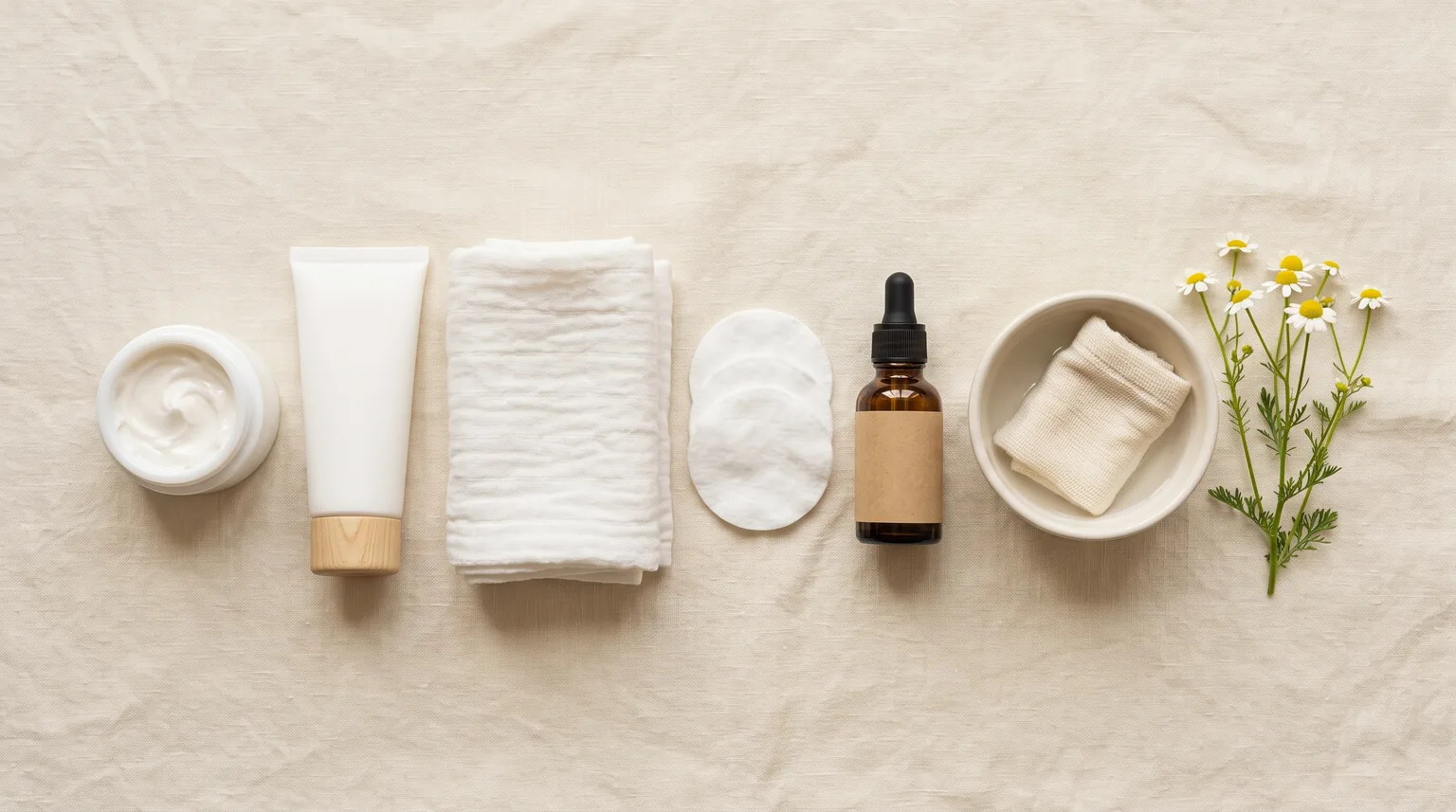
Standing in front of the baby aisle usually raises more questions than it answers: bath every day or not, cream or no cream, which wash, and why does that bottle marked “gentle” have an ingredient list as long as a novel. The useful thing to know is that the American Academy of Pediatrics and the NHS agree on a short routine, and that almost everything else on the shelf is optional.
Why a newborn's skin needs treating differently
It's thinner than adult skin: in babies aged 3 to 24 months the outermost layer, the stratum corneum, measured about 30% thinner and the epidermis about 20% thinner. In a healthy full-term newborn the skin barrier already works at birth, but it keeps maturing over the first years. In practice it dries out easily and gets irritated by things that would do nothing to us — a scented wipe, a skin fold left damp, too much soap. The AAP notes that a premature baby's skin is highly prone to injury, so for preemies ask the ward staff or your pediatrician for specific advice.
Hence the rule behind everything else: fewer products, simpler ones, applied gently.
Washing a newborn: not every day, warm water, dry the folds
A bath isn't there to “disinfect” a newborn. The AAP notes that newborns rarely sweat or get dirty enough to need a full bath often: three baths a week in the first year may be enough, and bathing more often can dry out the skin. The NHS says the same — you don't need to bathe your baby every day, and can wash the face, neck, hands and bottom instead (“topping and tailing”). A few fixed points:
- Sponge baths until the cord stump falls off, which usually happens by one or two weeks of age; then first baths as gentle and brief as possible (AAP).
- Warm, not hot, water: about 2 inches in the basin, checked with the inside of your wrist or elbow and mixed so there are no hot patches. The AAP recommends that the hottest water at the faucet be no more than 120 °F to help avoid scalds. Never leave a baby alone in the bath, even for a second.
- Soap sparingly. The NHS says you can use just water or a liquid cleanser suitable for babies; the AAP advises mild, neutral-pH soaps without additives only where needed, rinsed off right away.
- Dry the folds properly — neck, armpits, groin, behind the ears — patting, not rubbing.
The AAP suggests washing the hair two or three times a week with a mild shampoo or body wash. The scaly patches of cradle cap are harmless and outgrown: you can loosen them with a soft-bristled brush while shampooing, or simply leave them alone.
Moisturising newborn skin: when it's needed, and with what
Skin that peels in the first weeks is normal, not a problem to fix. If the skin is dry, the AAP suggests patting the baby dry after the bath and applying a small amount of fragrance-free, hypoallergenic moisturizing lotion to help prevent dry skin or eczema. A short ingredient list is the best sign on the label: fewer ingredients, fewer chances of a reaction.
If there's a family history of eczema, asthma or allergies, the question of how and how much to moisturise belongs with your pediatrician, not with a tube of cream.
The diaper area: prevention costs less than treatment
It's the most exposed part of the body: moisture, rubbing, urine and stool all at once. The routine the AAP and the NHS describe is unspectacular and effective.
- Change wet or dirty diapers as soon as possible, and clean the skin with water or with wipes free of alcohol and fragrance.
- Pat dry and let the skin air-dry; leave the diaper off when you can, and make sure it isn't too tight.
- A barrier cream during red spells: the AAP says the brand matters less than the ingredients, names zinc oxide and petrolatum as good choices and prefers fragrance-free products. If the cream isn't soiled, there's no need to rub it off at each change: add more on top.
- No talcum powder and no antiseptic creams on diaper rash (NHS).
Once the redness is already there the question changes: telling irritation apart from a yeast rash and knowing when to call the doctor is what the guide to diaper rash is for.
Umbilical stump, eyes, ears
For the umbilical stump, the AAP says there is no need for alcohol: keep it clean and dry and fold the diaper below it so urine doesn't soak it. The NHS adds that you only need to wash around it if it gets dirty with pee or poo, with cotton wool and warm water, patting it dry. Contact your pediatrician if you see foul-smelling yellowish discharge, red skin around the base, or the baby cries when you touch it, if the cord actively bleeds, or if the stump is still there after 3 weeks.
For the eyes, the NHS describes cotton wool dipped in warm water, wiped from the nose outward, with a fresh piece for each eye so as not to carry stickiness or infection from one eye to the other. For the ears, clean around them but not inside: never use cotton buds inside a baby's ears.
Babies and the sun: under six months, shade first
Both the AAP and the NHS say to keep babies under 6 months out of direct sunlight: shade under a tree, an umbrella or the stroller canopy, lightweight clothing with a tight weave that covers the body, and a hat with a brim. The AAP adds that under 6 months sunscreen can be used on small areas such as the face if protective clothing and shade are not available.
After 6 months sunscreen can go on all exposed areas, careful around the eyes. The AAP recommends a broad-spectrum sunscreen of at least SPF 15 (up to SPF 50), avoiding oxybenzone if possible and choosing zinc oxide or titanium dioxide for sensitive areas; the NHS recommends at least SPF 30. Either way, sunscreen is an addition to shade, clothes and a hat, not a reason to stay in the sun longer.
Reading a baby skincare label: what to look for and what to leave on the shelf
Good signs:
- explicitly marked for babies;
- a short, readable ingredient list;
- no fragrance at all, not “delicate fragrance”.
Best avoided in the first months:
- fragranced washes, wipes and creams, and wipes containing alcohol;
- bubble bath, bath oils and bath additives;
- talcum powder;
- antiseptic creams and lotions on diaper rash, and alcohol on the cord stump.
One note that's worth the reading time on its own: “natural” and “organic” are not synonyms for safe. They say where an ingredient comes from, not how a baby's skin will react to it. The ingredient list counts; the word on the front doesn't.
If a skin reaction appears
One new product at a time. If redness or irritation shows up after using it, stop that product straight away and go back to the essentials. The AAP notes that an allergy to an ingredient in a diaper, wipe or cream tends to appear after every exposure to that product and wherever it is applied.
These deserve a call to the doctor:
- diaper rash that isn't going away or is getting worse after two to three days of treatment;
- pimples, blisters, peeling, pus-filled, oozing or crusty sores, or a rash that is especially painful;
- a rash together with a fever (taken with a reliable thermometer);
- signs of infection around the umbilical stump.
In case of a severe, sudden reaction — swelling of the face or lips, difficulty breathing — don't wait: call your local emergency number (911 in the US, 999 in the UK).
Newborn skin care in short
Looking after a newborn's skin comes down to a few things done well: not too many baths, warm water, soap sparingly, folds dried carefully, a fragrance-free moisturiser when the skin is dry, frequent changes and a barrier cream in the diaper area, and shade and clothes for babies under six months. Everything else on the shelf is nearly always surplus — and every ingredient fewer is one reason fewer for irritation.
Frequently asked questions about newborn skin care
Why does a newborn’s skin need different products from mine?
Because it is thinner: the outermost layer, the stratum corneum, measured about 30% thinner than an adult’s and the epidermis about 20% thinner in babies aged 3 to 24 months. In a healthy full-term newborn the skin barrier already works at birth, but it keeps maturing over the first years. That is why the sensible choice is few, gentle, fragrance-free products: the AAP advises using soap sparingly and, where a cleanser is needed, only mild, neutral-pH soaps without additives.
What should I look for in a moisturiser for a newborn?
Something fragrance-free and hypoallergenic, with a short ingredient list. The American Academy of Pediatrics suggests patting the baby dry after a bath and applying a small amount of fragrance-free, hypoallergenic moisturizing lotion to help prevent dry skin or eczema. Peeling skin in the first weeks is normal and does not need treating.
Which products are best avoided on a newborn’s skin?
Anything fragranced, including scented wipes and creams: the AAP lists fragrances and preservatives in wipes and creams among common allergens, and recommends wipes free of alcohol and fragrance. The NHS advises against soaps, baby lotion and bubble bath on nappy rash, and against talcum powder and antiseptic creams. Alcohol is not needed on the umbilical cord stump either.
Can you put sunscreen on a newborn?
Shade and clothing come first: both the AAP and the NHS say to keep babies under 6 months out of direct sunlight. The AAP adds that under 6 months sunscreen can be used on small areas such as the face if protective clothing and shade are not available, and recommends a broad-spectrum sunscreen of at least SPF 15 (up to SPF 50), avoiding oxybenzone if possible. The NHS recommends at least SPF 30.
Does “natural” or “organic” mean a product is safe for a newborn?
No. Those words describe where ingredients come from, not how a baby’s skin will react to them, and a plant extract can be a fragrance ingredient like any other. What counts is the ingredient list: fragrance-free and short.
When should I call the doctor about a skin problem?
If a reaction appears after using a new product (stop it straight away), or, for diaper rash, if the AAP’s warning signs appear: the rash is not going away or is getting worse after two to three days of treatment, it has pimples, blisters, peeling, pus-filled or oozing sores, it is especially painful, or the baby has a fever. The NHS says to see a health visitor or GP if nappy rash does not go away, gets worse or spreads, or if the baby has a high temperature.
Sources
- Stamatas GN, Nikolovski J, Luedtke MA, Kollias N, Wiegand BC — Infant skin microstructure assessed in vivo differs from adult skin in organization and at the cellular level, Pediatric Dermatology 27(2), March–April 2010 (accessed September 26, 2026). Source for: the stratum corneum about 30% and the epidermis about 20% thinner than in adults, measured in babies aged 3 to 24 months.
- Telofski LS, Morello AP, Mack Correa MC, Stamatas GN — The Infant Skin Barrier: Can We Preserve, Protect, and Enhance the Barrier?, Dermatology Research and Practice, September 4, 2012 (accessed September 26, 2026). Source for: a skin barrier that is competent at birth in healthy full-term newborns and keeps maturing through the first years.
- American Academy of Pediatrics, HealthyChildren.org (Dipesh Navsaria, MD, FAAP) — Bathing Your Newborn (last updated July 6, 2025; accessed September 26, 2026). Source for: bath frequency, sponge baths until the cord falls off, water depth and temperature, 120 °F at the faucet, soap sparingly, shampoo two or three times a week, cradle cap, moisturiser after the bath, preemie skin.
- American Academy of Pediatrics, HealthyChildren.org — Umbilical Cord Care in Newborns (last updated July 6, 2025; accessed September 26, 2026). Source for: no alcohol on the stump, diaper folded below it, signs of infection, stump off by 3 weeks.
- American Academy of Pediatrics, HealthyChildren.org (Ingrid Polcari, MD, FAAP) — Common Diaper Rashes & Treatments (last updated December 18, 2024; accessed September 26, 2026). Source for: diaper-area routine, zinc oxide and petrolatum barrier creams, fragrances and preservatives as allergens, when to call the pediatrician.
- American Academy of Pediatrics, HealthyChildren.org — Sun Safety: Information for Parents About Sunburn & Sunscreen (last updated August 9, 2024; accessed September 26, 2026). Source for: babies under 6 months out of direct sunlight, sunscreen on small areas under 6 months, SPF 15 to 50, oxybenzone, zinc oxide and titanium dioxide.
- NHS — Washing and bathing your baby (page last reviewed July 23, 2024), Nappy rash (page last reviewed August 28, 2026) and Sunscreen and sun safety (page last reviewed March 24, 2026), all accessed September 26, 2026. Source for: topping and tailing, water or a baby cleanser, eyes and ears, the cord area, nappy rash do's and don'ts, babies under 6 months out of direct sunlight, SPF 30.