
Tech for newborns: what you need vs pure marketing
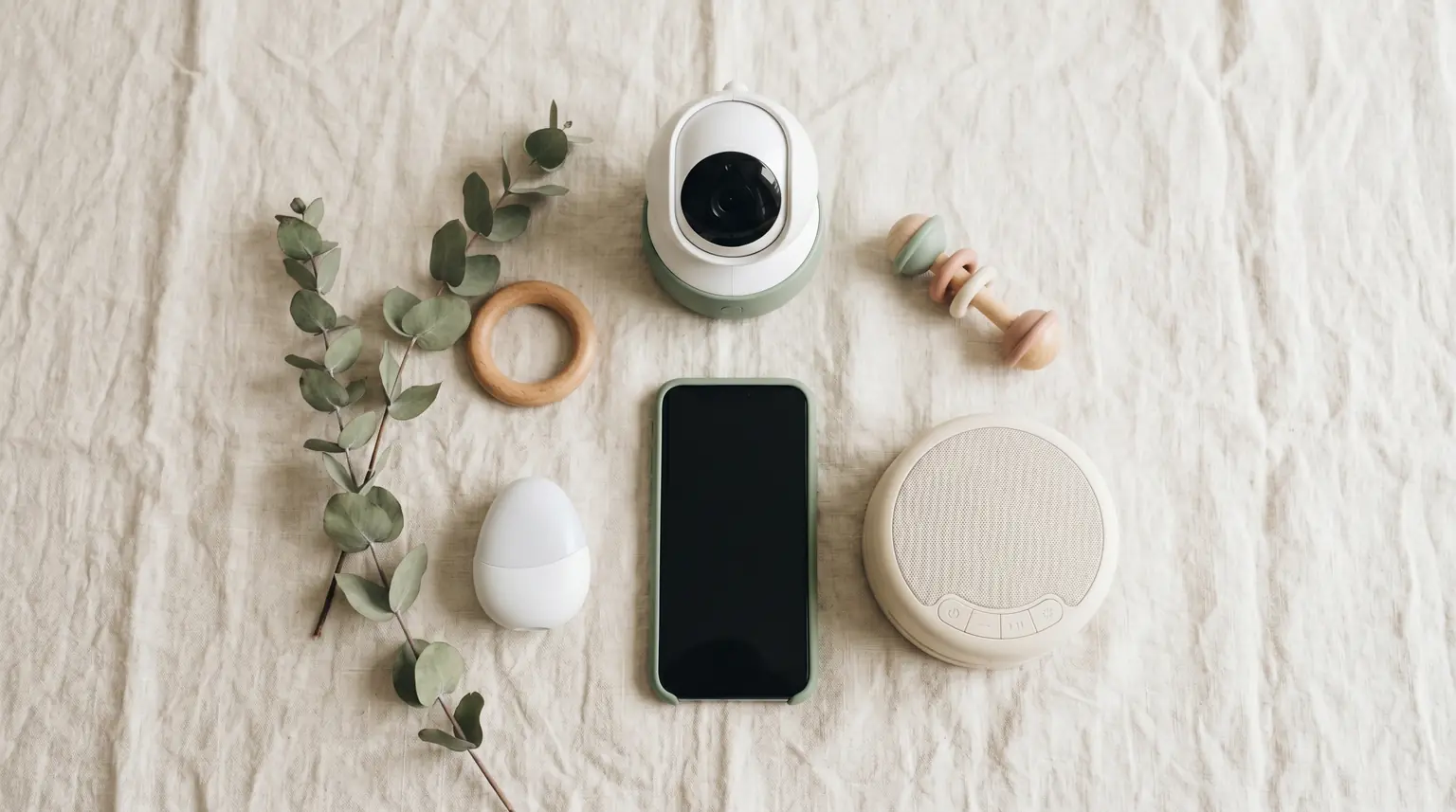
The baby monitor: let's start with the serious stuff
Some kind of baby monitor is genuinely useful, especially if the nursery is far from the parents' bedroom or there's more than one room between you and the baby. There's not much debate about that.
The real debate is: audio or video?
The classic audio monitor — the one with two walkie-talkie units — has a big advantage: it doesn't connect to the internet, so it can't be hacked, it doesn't depend on the Wi-Fi dropping at 3 a.m., it doesn't send data to servers around the world. It just works. For the first few months, when the baby mostly sleeps and you only want to hear if they cry, it's more than enough. It also costs less: $40–90 for a good model.
Video adds the option of looking without getting up, and that, honestly, is life-changing. Especially if your baby is one of those who make weird noises in their sleep and you never know whether to step in or not. It gives you a different kind of reassurance: you see them breathing, you see they're lying properly, and you go back to sleep.
Video monitors that use a smartphone app feel super convenient — and they are — but they come with two problems worth knowing before you buy. First, they depend on your phone: if the battery dies or the app closes, the monitor stops working. Second, they're connected to the internet, which means a minimum of security hygiene (a strong password, firmware updates, a serious brand that actually ships patches). Cases of hacked baby cameras have absolutely happened — they're not an urban legend.
If you can only pick one: a good video monitor with its own dedicated screen (not a smartphone) from an established brand is the best compromise. No internet connection, no dependence on your phone, it just does its job for years. The rest of the sleep setup, from crib to sleep sack, is in our newborn sleep essentials guide.
"Lifesaving" baby sensors and smart socks: easy does it
Smart socks, sensor mats, breathing monitors. This is the category where the marketing is loudest and where pediatricians, on average, are the most skeptical.
The pitch is seductive: a device alerts you if the baby's heart rate drops, if they stop breathing, if their temperature spikes. It sounds like the dream of every new parent terrified of SIDS (Sudden Infant Death Syndrome).
The problem is that measuring isn't protecting. Many of these devices are sold as consumer wellness products, which don't have to meet the requirements for medical devices. One — the Owlet Dream Sock — was classified by the FDA in November 2023 as an over-the-counter infant pulse rate and oxygen monitor: that tells you what it measures, and the FDA's own wording says it isn't meant to catch every episode or to replace traditional monitoring. It says nothing about preventing SIDS. On accuracy, a Children's Hospital of Philadelphia study published in JAMA in 2018 tested two models of the time on hospitalized infants: one picked up most drops in oxygen but not all of them, the other never detected them and showed a slow heart rate that wasn't there. A false alarm at 4 a.m. costs you years of your life every time. And, most importantly: there's no evidence that they reduce SIDS risk.
The American Academy of Pediatrics and the NIH Safe to Sleep campaign repeat the same message: to reduce the risk of SIDS, the things that actually work are different. Put the baby to sleep on their back, on a firm, flat surface with only a fitted sheet, with no pillows or soft blankets, in the parents' room but in their own crib or bassinet (for at least the first 6 months), and without letting them get overheated. That works. The AAP puts it plainly: if a monitor reassures you, it's fine to use one, just not as a substitute for these rules.
If your baby was premature or has specific medical conditions, your pediatrician will eventually prescribe an actual medical device — not the one you buy online. For a healthy baby, the real risk is that these gadgets ramp up your anxiety instead of easing it.
Smart home in the nursery: where it actually makes sense
Surprisingly, here there is something useful. Just not what you'd expect.
A smart thermo-hygrometer is one of those boring things that genuinely helps. Neither the AAP nor Safe to Sleep gives a target number for the nursery: what they warn about is overheating, which raises SIDS risk, so dress the baby for the temperature of the room. Being able to glance at the temperature from your phone, and to see how dry the air gets, especially in winter with the heating on, is useful and cheap ($15–30).
Smart bulbs with warm tones and a dimmer are another thing that changes nights. A bulb that turns on at 5% intensity with an amber glow when you get up for the night feed, without waking the baby and your partner, is worth every cent. Set them up once and they work for years.
White noise, if your baby needs it, is better coming from a dedicated machine than from a phone app. Apps get interrupted by notifications, they close, they tie up your phone. A $30 machine does only that, and does it well.
What you don't need: voice assistants in a newborn's room (who is talking to whom — a three-month-old?), smart air purifiers unless there's a real allergy or pollution issue, "intelligent" ultrasonic humidifiers when a regular one does the same job at a third of the price.
| Nursery gadget | Verdict | Why |
|---|---|---|
| Smart thermo-hygrometer | Useful | Shows at a glance whether the room is getting too warm and how dry the air is; costs $15–30. |
| Smart bulbs with a dimmer | Useful | Low-intensity amber light for the night feed, without waking the baby or your partner. |
| Dedicated white noise machine | Useful | Doesn't get interrupted by notifications like a phone app; about $30. |
| Voice assistant in the nursery | Skip | There's no one for it to talk to — a newborn doesn't use it. |
| Smart air purifier | Skip | Only useful with a real allergy or pollution issue. |
| "Intelligent" ultrasonic humidifier | Skip | A regular model does the same job at a third of the price. |
One rule before buying baby tech: real problem or anxiety?
At some point I switched off one of two baby monitors, uninstalled two apps, and put my phone on do-not-disturb except for calls. And I slept better.
The truth is that baby tech has a strange effect: the more sensors you add, the more data you get, the more you convince yourself that without that data you'd be in danger. It's a vicious circle. Moms in the '80s had none of this and we're all here telling the story.
A good rule, when you're about to buy yet another gadget, is to ask yourself: does this solve a real problem I have, or does it solve an anxiety I built up by reading reviews?
If it's the second — and it is, more often than you'd think — the baby doesn't need it. You do. And maybe, instead of another sensor, what you actually need is someone to tell you you're already doing enough.
Frequently asked questions about tech for newborns
Is an audio or video baby monitor better?
It depends on what you need. The classic audio monitor doesn't connect to the internet, so it can't be hacked and doesn't depend on Wi-Fi; it costs $40–90 and is more than enough for the first few months. Video lets you look without getting up, which helps if your baby makes strange noises in their sleep, but it depends on your phone's battery and requires attention to security (a strong password, firmware updates). The best compromise is a good video monitor with its own dedicated screen, not a smartphone app, from an established brand.
Do "lifesaving" sensors (smart socks, breathing monitors) actually work?
They measure; they don't protect. Many are consumer wellness devices that don't have to meet the requirements for medical devices; one, the Owlet Dream Sock, was classified by the FDA in November 2023 as an over-the-counter infant pulse rate and oxygen monitor, which tells you what it measures, not that it prevents anything. A 2018 JAMA study of two models of the time found missed drops in oxygen and false low-heart-rate readings. And there's no evidence they reduce SIDS risk: the American Academy of Pediatrics says not to use them for that purpose.
What actually lowers the risk of SIDS?
According to the American Academy of Pediatrics and the NIH Safe to Sleep campaign: put the baby to sleep on their back, on a firm, flat surface with only a fitted sheet, with no pillows or soft blankets, in the parents' room but in their own crib or bassinet (for at least the first 6 months), and without letting them get overheated. The smart sock with a sensor doesn't replace any of it.
Which smart devices for the nursery are genuinely useful?
Three in particular: a smart thermo-hygrometer ($15–30) to check that the room isn't getting too warm, since overheating raises SIDS risk, and how dry the air is; smart bulbs with warm tones and a dimmer for the night feed without waking anyone; and a dedicated white noise machine (about $30), more reliable than a phone app.
Which baby tech gadgets can you skip?
Voice assistants in the nursery (who's a three-month-old talking to?), smart air purifiers unless there's a real allergy or pollution issue, and "intelligent" ultrasonic humidifiers when a regular one does the same job at a third of the price.
How do you know if a baby gadget is genuinely necessary?
Ask yourself whether it solves a real problem you have, or an anxiety you built up by reading reviews. If it's the second, the baby doesn't need it — you do.
Sources
- American Academy of Pediatrics, HealthyChildren.org (Rachel Y. Moon) — How to Keep Your Sleeping Baby Safe: AAP Policy Explained (last updated September 11, 2026; accessed September 25, 2026). Source for: back sleeping on a firm, flat surface, no soft bedding, room sharing without bed sharing for at least the first 6 months, avoiding overheating, and no evidence that consumer heart rate and pulse oximetry monitors decrease SIDS risk.
- Safe to Sleep campaign, Eunice Kennedy Shriver National Institute of Child Health and Human Development (NIH) — Ways to Reduce Baby's Risk (no date shown on the page; accessed September 25, 2026). Source for: the same recommendations, dressing the baby for the temperature of the room, and not using heart, breathing or motion monitors to reduce the risk of SIDS.
- US Food and Drug Administration, Center for Devices and Radiological Health — De Novo classification order DEN220091, Dream Sock (November 8, 2023; accessed September 25, 2026). Source for: the Dream Sock's classification as an over-the-counter infant pulse rate and oxygen saturation monitor, and its stated limits (not every episode is notified, not a replacement for traditional monitoring).
- Bonafide CP, Localio AR, Ferro DF, Orenstein EW, Jamison DT, Lavanchy C, Foglia EE, Children's Hospital of Philadelphia — Accuracy of Pulse Oximetry-Based Home Baby Monitors, JAMA 320(7), August 21, 2018 (accessed September 25, 2026). Source for: the missed drops in oxygen and the false slow-heart-rate readings on two consumer monitors tested on hospitalized infants.