
First day trips with a newborn: planning and packing
When you “can” start going out
There's no magic age. Your pediatrician will tell you more or less the same thing they told me: after the first two or three weeks, if mom and baby are doing well, a walk or a short outing not only can be done, it's actually good for you. Fresh air, natural light, a change of scenery for mom — these all matter.
The working rule is: the smaller the baby, the smaller the trip. The first outings are often a 90-minute drive, a couple of hours at the park, and back home. The classic “day trip” — a lake, a farm stay, a medieval village an hour from home — becomes realistic around the second month, when feedings space out and sleep starts to fall into some kind of pattern.
Timing: the one thing that changes everything
The classic mistake is planning around adult schedules. Leave at 10, lunch at 1, back at 6. With a newborn that basically never works.
What does work is planning the trip around the baby's rhythm, not the other way round. The question isn't “what time do we get up?”, it's: when does the baby sleep the most? That's your useful window for getting around.
For most newborns the soundest sleep of the day is in the morning, between 9 and 12. Translation: leave at 9, arrive at 10:30, enjoy two calm hours with the baby asleep in the carrier or stroller, and then handle feeding plus a change somewhere sheltered. It's a thousand times better than leaving at 7 (waking everyone) or at 11 (when they've just finished sleeping and are hungry).
The plan B that saves your day
A trip with a newborn is never linear. Always plan one stop along the way: a decent service area, a café with a bathroom, a church with a shaded forecourt. A place where you can get out, change a diaper, breastfeed calmly, or warm up a bottle.
The rule I set for myself after the second failed trip: never more than an hour's drive without a stop marked on the map. It doesn't matter if you end up not needing it. Knowing it exists changes your stress level dramatically.
And always have an early-return plan. If the baby cries non-stop for 40 minutes, the trip is over. That's not a failure, it's information: next time you'll stay closer to home or leave at a different time. That's how you learn, not by reading blogs.
What to pack (the real list, not the idealized one)
The temptation is to bring everything. I know because I did it the first time: a 35-liter backpack, filled to the brim, of which I used 20%. The truth is that for a half-day trip you need far less than you think.
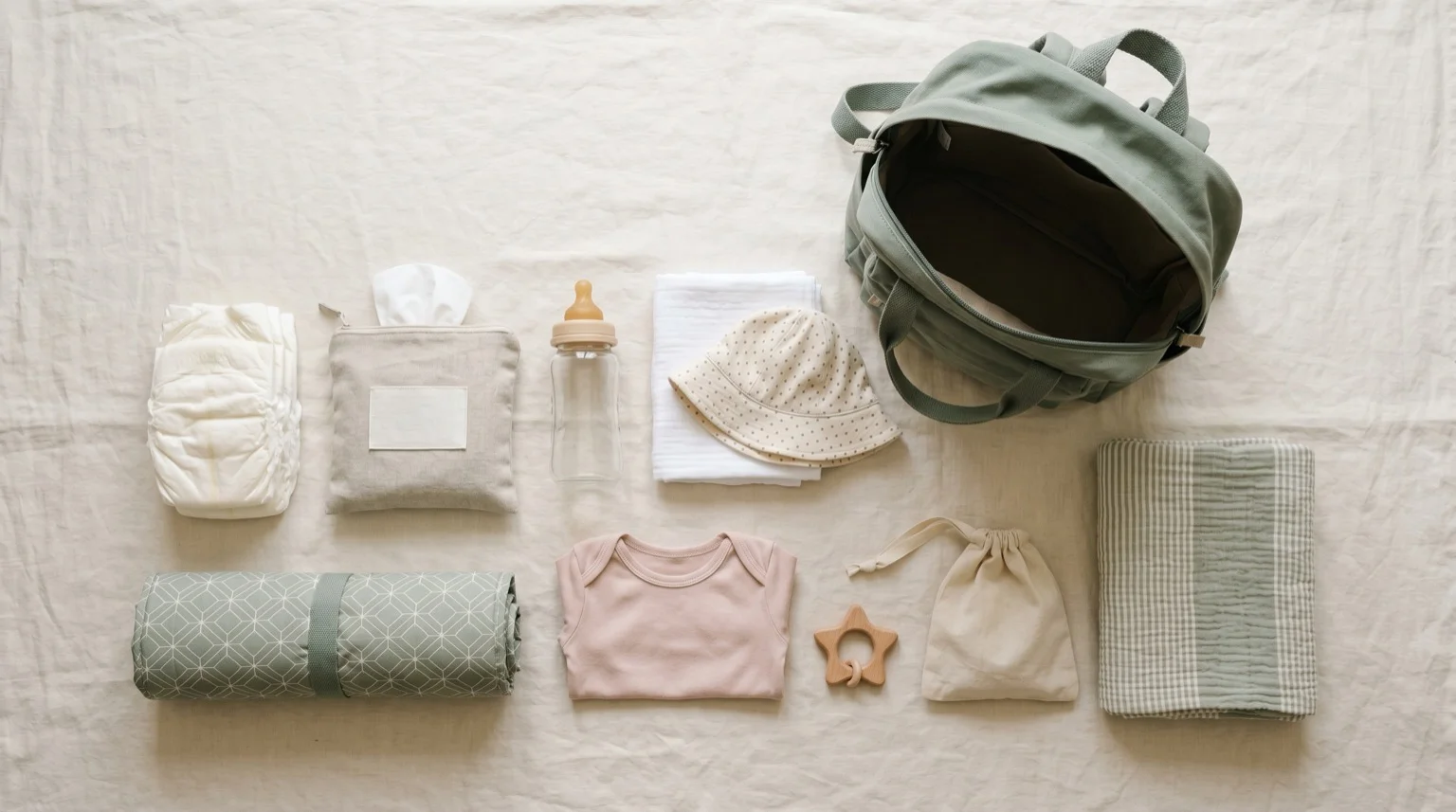
A realistic minimum list for 5-6 hours out with a baby under 6 months:
Diapers: one every 2 hours of the trip, plus 2 spares. For 5 hours that's 4-5 diapers in total.
Wipes: a whole pack. They're useful for everything, not just the bottom.
A full change of clothes: bodysuit, onesie, socks. Just one — two if the trip is longer or it's a season when they sweat.
A portable changing mat: it seems like a non-essential until you find yourself changing the baby on the hood of a car.
Bags for dirty diapers: 3-4. The scented sealable ones are a blessed invention.
Feeding: if you breastfeed, all you need is a nursing cover or a large scarf. If you use formula, two pre-measured bottles with the water already measured out plus a small container with the powder kept separate (never pre-mixed: it expires in 2 hours).
A spare pacifier: two. One always falls, always.
A light blanket or cotton wrap: works as a sheet, as a nursing cover, as a changing cloth if needed.
An extra hoodie or onesie for the baby: even in summer. In the shade in the evening it's cooler than you'd think.
Water and snacks for you: a breastfeeding mom dehydrates fast and forgets to eat. A half-liter water bottle and a bar in the bag make the difference.
The baby's documents: health card, tax code. If you're abroad, a photocopy of the ID card too.
Newborn-specific sunscreen (from 6 months on): SPF 50+, mineral formula. Under 6 months, shade and a hat are better.
What you do not need, even if the blogs say you do: a thermometer, assorted ointments, a first-aid kit, a change of clothes for yourself “in case of spit-up” (the small towel in the bag does the same job), noisy toys. A 3-month-old doesn't need entertainment, they need you.
The diaper backpack: the features that really matter
The diaper backpack is one of those objects that, if it's the right one, you forget it even exists. If it's the wrong one, it ruins every trip.
What to look for, in order of importance:
1. Wide, padded straps. With 4-5 kg of contents, narrow straps cut into your shoulders after an hour. Look for straps at least 5-6 cm wide with memory foam or EVA padding.
2. A wide opening, ideally book-style. Narrow top openings seem convenient in the shop. In reality, when you're standing at a service area digging for a clean bodysuit in the middle of everything else, you go crazy. A backpack that opens like a book wins every time.
3. Insulated side pockets. One for the warm bottle (if you use formula), one for water. They need to be accessible without opening the main compartment.
4. An included, attached changing mat. Don't buy the backpack and then a separate mat — it always ends up never being where you need it. Almost all decent diaper backpacks have a removable mat sewn or clipped in.
5. The option to clip it to the stroller. Two carabiner clips or velcro straps that fix to the stroller handlebar. It's the difference between having your hands free and carrying it on your shoulder all day.
6. Wipeable material. If it doesn't clean with a wipe of a damp cloth, sooner or later it becomes a disaster. Spit-up milk, baby food, wipes that opened by accident — everything happens.
A few models on Amazon to get your bearings
Four different categories, from compact to extra-organized. The links are searches on Amazon filtered by category: you'll see the most reviewed models at that moment, instead of a single product that might end up out of stock.
🎒 Multifunction diaper backpacks — the entry-level category, $50-90. Perfectly fine for the first trips. Look for models with at least 1,000 reviews and an average above 4.5 stars.
🧳 Skip Hop — diaper bag range — an American brand with an excellent reputation for internal organization and durability. The $60-120 range. The Skip Hop “Forma” or “Mainframe” backpack is a classic you'll see around for years.
🌿 BabaBing — the eco option — a British brand with lines made from recycled material (rPET). A more understated look, light weight. A good compromise if environmental impact matters to you too.
🎨 Storksak — a design that's a little less “baby” — for anyone who wants a diaper backpack that doesn't look like a diaper backpack. Urban-backpack lines, careful finishes. It costs more (premium diaper bags run $190-240), but you keep using it afterwards, once the baby no longer needs the changing mat.
Baby carrier or stroller?
For a proper day trip, the honest answer is: both. The stroller in the car for when they sleep or you cover a lot of ground, and an ergonomic carrier for when you head into the villages, the trails of a park, the stairs of a farm stay.
If you have to choose just one for the first trips, choose the carrier. A small baby sleeps better against you, your hands are freer than they seem, and wherever you go they go with you. The stroller is a godsend for long stretches, but it's also a bulky thing that becomes a problem in half of the beautiful places (historic centers, steps, cobblestones, elevators that only half work).
🧷 Ergonomic newborn carriers — search for the words “ergonomic” and “m-position”. Carriers that hold the baby with their legs dangling are advised against by pediatricians for the first months.
The rule of three, to keep your sanity
Before setting off I gave myself a rule of three, to avoid performance anxiety:
1. For your first day trip, choose a place you know. Not a new farm stay 70 km away, but the regional park you always go to, or the village where you spent that birthday last year. Familiarity + baby = a manageable stress level.
2. Be back by nap time. Not “back in the evening”: back by the time the baby usually takes the long nap at home. If that nap is at 4 pm, you need to be in the car at 3. Full stop.
3. No perfect photos. The first trip doesn't have to be an Instagram set. It has to be the moment when you, out of the house, realize you can do this. Everything else, in time, comes on its own.
And if the first trip goes badly — a baby crying the whole way, an early return, a skipped lunch — that's okay. I went through it too. What matters is that the second one is already easier.
Frequently asked questions
When can you take a newborn on their first day trip?
There's no magic age: if mom and baby are doing well, a walk or short outing after the first two or three weeks is good for you. A proper day trip (a lake, a farm stay, a medieval village an hour from home) becomes realistic around the second month, once feedings space out and sleep starts to fall into a pattern.
What's the best time to leave with a newborn?
Plan around the baby's rhythm, not the adults'. For most newborns the soundest sleep of the day is in the morning, between 9 and 12: leaving at 9 and arriving around 10:30 lets you make the most of that calm window.
What do you actually need to pack for a half-day trip?
For 5-6 hours out with a baby under 6 months, you need a few diapers (one every 2 hours plus 2 spares), a full pack of wipes, a full change of clothes, a portable changing mat, bags for dirty diapers, feeding supplies, a spare pacifier, a light blanket, an extra layer for the baby, water and snacks for you, and the baby's documents. You don't need a thermometer, ointments, a first-aid kit, or noisy toys.
Carrier or stroller for the first trips?
If you have to choose just one, choose the carrier: a small baby sleeps better against you and your hands are freer than they seem, while the stroller becomes bulky in historic centers with steps or cobblestones. For longer trips, though, it's best to have both.
What if the baby cries and the trip doesn't go as planned?
That's normal: if the baby cries non-stop for 40 minutes, it's best to head home early. That's not a failure, it's information for planning the next outing better — maybe staying closer to home or leaving at a different time.
What features matter most in a diaper backpack?
The most important are wide, padded straps, a wide opening ideally book-style, insulated side pockets for the bottle and water, an included and attached changing mat, the option to clip it to the stroller, and wipeable material.