
Travel system, 2-in-1 or bassinet? How to choose
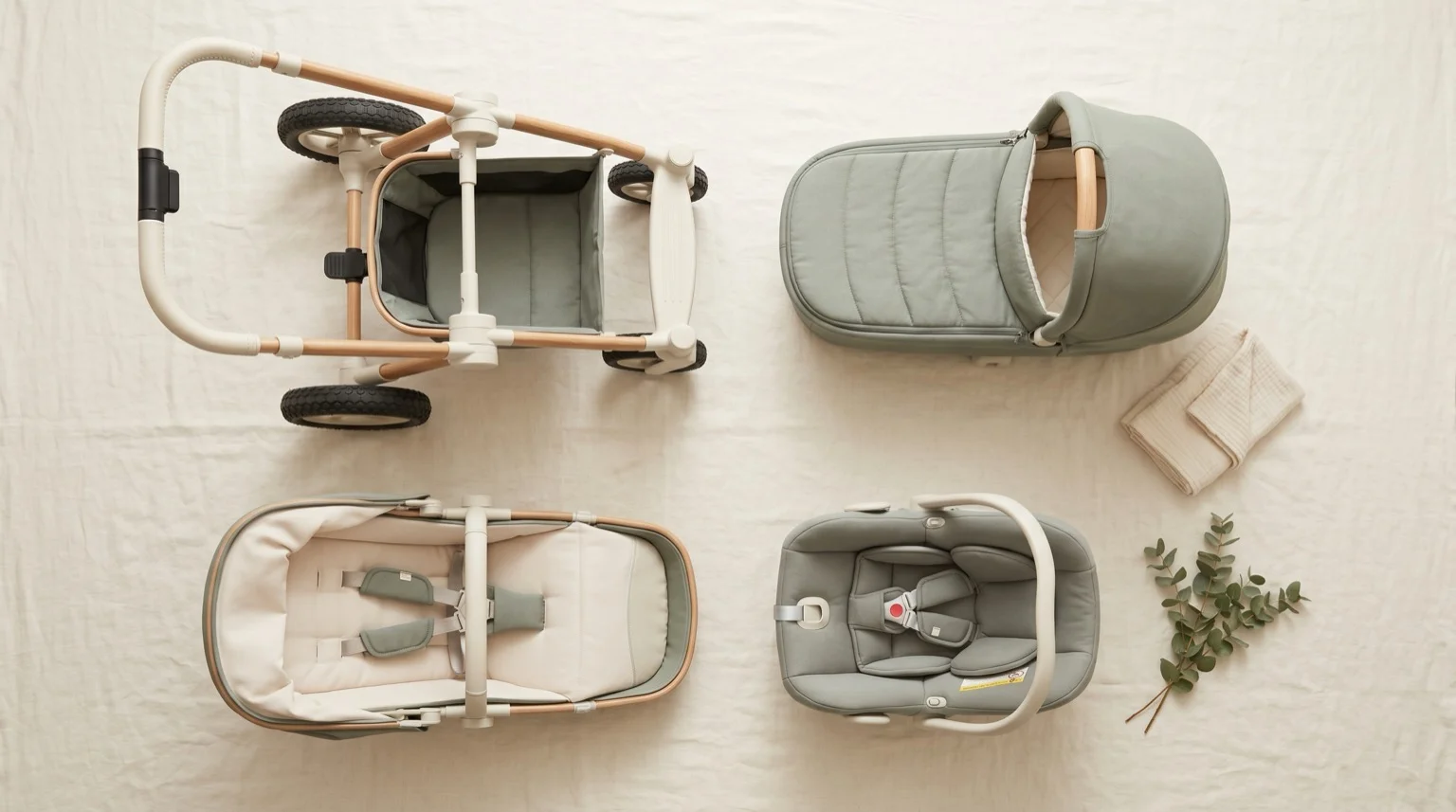
“Travel system, stroller with bassinet, or just a bassinet?” is one of the most anxiety-inducing questions when preparing for a baby. It is serious money, an object you'll push every day for years, and the right answer depends on how you actually live. This guide explains what changes between the three options and when each one is worth it.
What “3-in-1”, “2-in-1” and “bassinet” really mean
Manufacturers don't use these labels consistently, and in the US “travel system” often just means a stroller sold with a matching infant car seat. Read what is actually in the box:
- 3-in-1 travel system: one stroller frame with a lie-flat bassinet for the newborn months, a reclining toddler seat that can face you or the world, and a rear-facing infant car seat that clicks onto the frame and into a base in the car.
- 2-in-1 stroller (bassinet + seat): same frame, bassinet and toddler seat. No car seat included. Suited to those who choose the car seat separately, or who hardly use a car.
- Standalone bassinet: just the lie-flat carrycot, mountable on a compatible stroller frame. It's the choice for those who already have a frame or want to assemble a modular setup.
The 4 factors for choosing
1. How much will you drive in the first year?
If you drive most days, the travel system is the most convenient choice: the infant car seat lifts off the stroller frame and clicks into the car without taking the baby out.
If you drive only occasionally, a 2-in-1 plus a separate car seat is often the better buy. The infant seat bundled in a travel system is an infant-only seat: it can only be used rear-facing and is outgrown sooner. NHTSA notes that convertible and all-in-one seats typically have higher height and weight limits for the rear-facing position, so the child can stay rear-facing longer — and it recommends a seat with a higher rear-facing limit if a baby under 1 outgrows the infant seat. Every car seat sold in the US is certified to the same federal standard, so the choice is about fit and convenience, not about one type being approved and the other not. Our guide to choosing a car seat covers the rules in detail.
2. How much will you walk?
If you walk a lot (parks, daily strolls, walking to the store), the weight and maneuverability of the frame matter more than anything else. Compare the frame weight listed by the manufacturer, look for suspension, a height-adjustable handlebar and a one-handed fold. A heavy frame looks sturdy in the store and feels very different after a few months of lifting it into the trunk. Find lightweight strollers with suspension on Amazon
3. How much space do you have to store it?
Measure the trunk and the spot where you'll keep it at home before buying, and compare those measurements with the folded dimensions the manufacturer lists. Some compact strollers fold small enough to travel as carry-on; if that matters to you, check the airline's own size limits rather than the stroller's marketing. Find compact travel strollers
4. What's your budget?
Prices from the brands' own US websites, September 2026 (they change often):
- Around $135-300 — entry level: Baby Trend's travel systems sit in this range. Frames are heavier and fabrics simpler, but you get a stroller and an infant car seat that work together. Find entry-level travel systems on Amazon
- Around $300-500 — mid range: Evenflo's Pivot Xpand NXT travel system, for example, lists at about $380-480. Lighter frames, more seat positions, better canopies. Find the Evenflo Pivot Xpand
- From about $500 — premium modular strollers (Nuna, UPPAbaby, Bugaboo): Nuna's MIXX and TRIV strollers, for example, list from about $500 before any car seat, and the bassinet and car seat can be extra. An investment for those who walk a lot or plan to use it for more than one child. Find premium modular strollers
When a 3-in-1 travel system is worth it
- You drive most days.
- You value the “everything matched” convenience of a single box.
- You want frame, bassinet and car seat that are designed to fit each other.
- You plan to have more children and reuse the system.
The limit of a travel system is the infant car seat: it is rear-facing only and the child outgrows it by height or weight — the limits are printed on the seat's label — at which point you buy a convertible or all-in-one seat anyway.
When a 2-in-1 stroller (without car seat) is worth it
- You want to choose the car seat on its own merits — for example a convertible seat that stays rear-facing longer. NHTSA's Car Seat Finder lets you compare seats and their ease-of-use ratings. Find convertible car seats
- You rarely drive (city life, public transport, work within walking distance).
- You already have a car seat from an older sibling that is still within its date and has no open recalls.
How much a 2-in-1 saves depends on the car seat left out. In Evenflo's own US catalogue, for instance, the LiteMax infant seats that come bundled in its travel systems sell separately for about $150-300.
When a standalone bassinet is worth it
- You already have a compatible frame (from a sister, a friend, bought second-hand).
- You want a mixed modular setup: a frame from one brand with a car seat from another, joined by the adapters the frame manufacturer sells. Check its compatibility list first.
- You're on your second child: the first stroller is still great, but it came with only a toddler seat. Find stroller bassinets
Three stroller details that change the daily experience
Tires: foam-filled or air-filled?
Foam-filled or solid tires don't puncture and need less maintenance, but absorb bumps less. Air-filled tires roll better on gravel, grass and broken pavement — but they can puncture and need checking and pumping. For mostly sidewalk use, puncture-proof tires are the easier pick; for trails and parks, air-filled tires are more comfortable.
Height-adjustable handlebar
It seems like a detail, but if the two people pushing the stroller are very different heights, an adjustable handlebar saves a lot of back pain. It's more common in the mid and premium ranges.
Reversible seat
Many modular strollers let you turn the toddler seat parent-facing or world-facing. It's an option you'll use a lot in the first year and a half: facing you when the baby is sleepy, facing out when curious. Check it's included before buying.
What to check on a stroller in the store or on delivery
- One-handed opening and folding: it must work with the baby in your arms.
- Frame weight: lift it the way you would to put it in the trunk.
- Storage basket: roomy enough for groceries and the diaper bag.
- 5-point harness, with soft padding on the shoulders and between the legs.
- Canopy with a peekaboo window, to check on the baby without leaning over.
- Warranty: check its length and what it covers; it varies a lot between brands.
Tip: stroller as a group gift
The stroller is one of the most expensive items on a baby registry and often out of budget for a single gift. The simplest solution is to add it as a group gift: several people contribute the amount they choose, and the item gets covered without awkwardness. It's exactly the kind of item this feature exists for.
Which stroller setup suits you: the short version
- 3-in-1 travel system → you drive often, it's your first child, you want to simplify decisions.
- 2-in-1 + separate car seat → city life, or you want to pick a convertible car seat from day one.
- Just the bassinet → you already have a compatible frame or you're building a modular setup.
Whatever you choose, try it open and folded before taking it home, and check that it fits your trunk. It sounds obvious, and it is exactly the kind of thing people only discover after the box is open.
3-in-1, 2-in-1 or bassinet: quick comparison
| Type | What's included | When it's worth it |
|---|---|---|
| 3-in-1 travel system | Frame + bassinet + toddler seat + rear-facing infant car seat | Frequent driving, want everything matched |
| 2-in-1 stroller | Frame + bassinet + toddler seat (no car seat) | Rare driving, or want to choose the car seat separately |
| Standalone bassinet | Just the lie-flat carrycot | Already have a compatible frame, or building a modular setup |
Frequently asked questions about travel systems and strollers
What is the difference between a 3-in-1 travel system, a 2-in-1 stroller and a standalone bassinet?
A 3-in-1 travel system puts three pieces on one stroller frame: a lie-flat bassinet for the newborn months, a toddler seat, and a rear-facing infant car seat that clicks onto the frame. A 2-in-1 has the frame, the bassinet and the toddler seat, but no car seat. A standalone bassinet is just the lie-flat carrycot, to be mounted on a compatible frame you already own or buy separately.
Is a 3-in-1 travel system or a 2-in-1 stroller better?
If you drive often, the travel system is more convenient: the infant car seat lifts off the frame and clicks into its base in the car without taking the baby out. If you rarely drive, a 2-in-1 plus a separately chosen car seat can make more sense. An infant-only seat can only be used rear-facing and is outgrown sooner, while NHTSA notes that convertible and all-in-one seats typically have higher rear-facing limits, so the child can stay rear-facing longer.
How much does a travel system cost?
On the brands’ own US websites, Baby Trend’s travel systems sell for roughly $135 to $300 and Evenflo’s Pivot Xpand NXT travel system for about $380 to $480. Premium modular strollers (Nuna, UPPAbaby, Bugaboo) cost more: Nuna’s MIXX and TRIV strollers, for example, list from about $500 before any car seat. Prices change often, so check them when you add the item to your registry.
When is it worth buying just the bassinet?
In three cases: if you already have a compatible frame, if you want to build a mixed modular setup, or if you are on your second child and the first stroller came without a bassinet. Check the frame manufacturer’s compatibility list before buying.
Are foam-filled or air-filled tires better?
Foam-filled or solid tires don’t puncture and need less maintenance, but absorb bumps less. Air-filled tires roll better on gravel, grass and broken pavement, but can puncture and need checking and pumping. For mostly sidewalk use, puncture-proof tires are the easier pick; for trails and parks, air-filled tires are more comfortable.
Can a stroller be given as a group gift?
Yes: it is one of the most expensive items on a baby registry, so it suits a group gift, with several people contributing the amount they choose.
Sources
- National Highway Traffic Safety Administration — Car Seats and Booster Seats and How to Install Rear-Facing Car Seats (accessed September 26, 2026). Source for: infant-only seats are rear-facing only, convertible and all-in-one seats typically have higher rear-facing limits, the Car Seat Finder and ease-of-use ratings.
- Brand websites, US prices checked September 26, 2026: Baby Trend travel systems, Evenflo travel systems, Evenflo infant car seats and Nuna strollers.