
How to choose a car seat: safety first
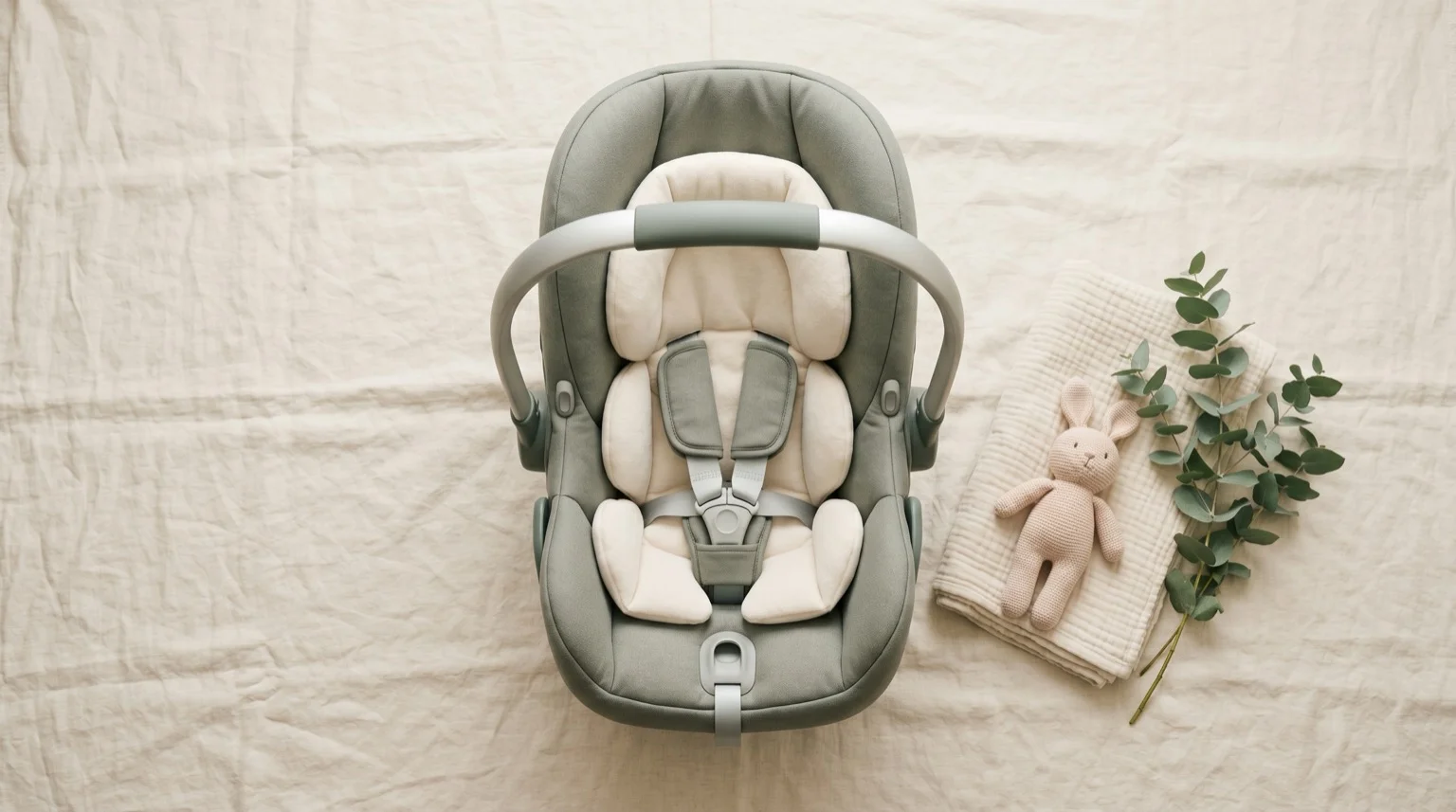
Of all the purchases you make for your baby, the car seat is the one where an absolute rule applies: choose it for fit and correct use, not for price. This guide explains the rules that actually apply where you live — the federal standard and NHTSA's recommendations in the US, the GOV.UK rules in the UK — which type of seat a newborn needs, and how to install it so it does its job.
The rules depend on where you live
United States: FMVSS 213 and NHTSA
Every car seat sold in the US is self-certified by its manufacturer to meet Federal Motor Vehicle Safety Standard 213, the federal standard for child restraint systems. Seats recommended for children up to 40 lb (18 kg) or 43 in (110 cm) must also meet the side-impact standard FMVSS 213a, and seats manufactured on or after December 5, 2026 are certified to the updated FMVSS 213b.
NHTSA states that every seat it rates for ease of use is certified to these federal standards, including the crash performance requirements. In practice, a more expensive seat buys you features — easier installation, higher limits, lighter weight, washable fabrics — not a different legal level of protection. What changes the protection your child actually gets is choosing a seat that fits your child and your vehicle and using it correctly every time.
Each state sets its own child passenger law on top of the federal standard, so check your state's rules as well; NHTSA lists child passenger safety contacts for every state.
United Kingdom: R129 and R44
According to GOV.UK, children must normally use a child car seat until they are 12 years old or 135 cm tall, whichever comes first. You can choose a seat based on your child's height or weight, and only approved seats can be used:
- Height-based seats (R129) carry a capital “E” in a circle and “R129” on the label. They must be rear-facing until the child is over 15 months old.
- Weight-based seats (ECE R44) carry a capital “E” in a circle and “ECE R44”, and are grouped by the child's weight, as in the table below.
| R44 group | Child's weight | Seat type (GOV.UK) |
|---|---|---|
| 0 | 0-10 kg | Lie-flat or lateral baby carrier, rear-facing baby carrier, or rear-facing baby seat with a harness |
| 0+ | 0-13 kg | Rear-facing baby carrier or rear-facing baby seat with a harness |
| 1 | 9-18 kg | Rear- or forward-facing seat with a harness or safety shield |
| 2 | 15-25 kg | High-backed booster seat or booster cushion |
| 3 | 22-36 kg | High-backed booster seat or booster cushion |
Manufacturers can now only make booster cushions approved as group 3; existing group 2 cushions can still be used.
Car seat types by age and size (NHTSA)
NHTSA's advice is to select a seat based on your child's age and size, choose one that fits your vehicle, and keep the child in each seat for as long as they fit within the manufacturer's height and weight limits:
| Age | Seat | What NHTSA recommends |
|---|---|---|
| Birth-12 months | Rear-facing: infant-only, convertible or all-in-one | Always rear-facing |
| 1-3 years | Rear-facing, then forward-facing with harness and tether | Rear-facing until the seat's top height or weight limit |
| 4-7 years | Forward-facing with harness and tether, then booster | Harness until the seat's top limit |
| 8-12 years | Booster seat, then seat belt | Booster until the seat belt fits properly |
For a baby registry, the choice is usually between two first seats:
- Infant-only seat. Rear-facing only, with a carrier that clicks in and out of a base left in the car. It is the seat bundled in most travel systems, and the one you can lift out without waking the baby. It is outgrown sooner.
- Convertible or all-in-one seat. Stays in the car. NHTSA notes that these seats typically have higher height and weight limits for the rear-facing position, so the child can stay rear-facing longer; when a baby under 1 outgrows an infant seat, a seat with a higher rear-facing limit is strongly recommended.
Keep the car seat rear-facing for as long as possible
NHTSA calls the rear-facing seat the best seat for a young child: it has a harness and, in a crash, cradles and moves with the child to reduce the stress on the fragile neck and spinal cord. Its recommendation is to keep the child rear-facing until they reach the top height or weight limit allowed by the seat's manufacturer — not until they reach the minimum for the next seat. Only then does the child move to a forward-facing seat with a harness and tether. In the UK, an R129 seat must stay rear-facing until the child is over 15 months old.
Car seat installation: where safety is really decided
- Read both manuals. NHTSA's first step is always the seat's instruction manual and the vehicle's owner manual: not every seat fits every vehicle, so try the seat in your car before you commit to it.
- Lower anchors or seat belt, never both. In the US every seat is installed with the vehicle's lower anchors (LATCH) or with the seat belt locked as the manual explains. Installed correctly, the seat should not move more than 1 inch side to side or front to back. In the UK, a seat can only be used with a diagonal seat belt unless it is designed for a lap belt or fitted with ISOFIX anchor points.
- Recline angle. Most seats that can be used rear-facing have a built-in angle indicator; the angle may need adjusting as the baby grows.
- A snug harness. Straps lie flat, through the slots at or below the child's shoulders when rear-facing, and are tight enough that you cannot pinch any extra material at the shoulder. On US seats, the chest clip sits at armpit level.
- No bulky coats under the straps. Bulky clothing or blankets prevent a snug harness fit: buckle the child in first, then put the coat or blanket over the harness.
- Tether for forward-facing seats. NHTSA recommends always using the tether with a forward-facing seat, where both the seat and vehicle manufacturers allow it.
- Get it checked. In the US, certified technicians at car seat inspection stations check your installation free of charge in most cases, and some offer virtual appointments. In the UK, the Child Car Seats website linked from GOV.UK explains how to choose and fit a seat.
- Register the seat. Send back the registration card or register on the manufacturer's website, so the manufacturer can contact you about recalls; NHTSA also sends recall alerts by email.
Front seat and air bags
A rear-facing seat must never be placed in front of an active air bag, and NHTSA advises that children under 13 ride in the back seat. GOV.UK requires any front air bag to be deactivated before a rear-facing baby seat is fitted in a front seat, and forbids child seats in side-facing seats.
New or second-hand car seat?
A second-hand seat is only an option if you can tick every line of NHTSA's used car seat checklist:
- It has never been in a moderate or severe crash.
- It still has its labels with the date of manufacture and model number — you need them to check for recalls and to know whether the seat is too old.
- It has no open recalls (some problems can be fixed by the manufacturer).
- It has all its parts and its instruction book.
On crashes, NHTSA recommends replacing a seat after a moderate or severe crash. After a minor one — the vehicle could be driven away, the door nearest the seat was undamaged, nobody was hurt, no air bags deployed and the seat shows no visible damage — it does not automatically need replacing. The seat manufacturer's instructions come first and can be stricter. A seat bought from a stranger online rarely comes with that history, which is why a new seat is the safer default.
If budget is the issue, the car seat is a natural group gift: several people contribute together so you can pick the seat that fits your child and your car rather than the cheapest one. Search for rear-facing infant car seats on Amazon
Frequently asked questions about choosing a car seat
Which safety standard does a car seat have to meet in the US?
Every car seat sold in the US is self-certified by its manufacturer to meet Federal Motor Vehicle Safety Standard 213 (FMVSS 213), the federal standard for child restraint systems, and seats for children up to 40 lb or 43 inches must also meet the side-impact standard FMVSS 213a. Seats manufactured on or after December 5, 2026 are certified to the updated FMVSS 213b. NHTSA notes that every seat it rates for ease of use meets these federal standards, including the crash performance requirements, so a higher price buys features and convenience, not a different legal level of protection.
What are the car seat rules in the UK?
According to GOV.UK, children must normally use a child car seat until they are 12 years old or 135 cm tall, whichever comes first. Only approved seats can be used: height-based seats carry an “E” in a circle and “R129” on the label and must be rear-facing until the child is over 15 months old; weight-based seats carry “ECE R44” and are grouped by weight, from group 0+ (0-13 kg, rear-facing) up to group 3 (22-36 kg).
Which type of car seat does a newborn need?
A rear-facing seat. NHTSA says a child under 1 should always ride rear-facing, either in an infant-only seat, which can only be used rear-facing, or in a convertible or all-in-one seat, which typically has higher rear-facing height and weight limits so the child can stay rear-facing for longer.
How long should a child ride rear-facing?
As long as possible. NHTSA recommends keeping a child in a rear-facing seat until they reach the top height or weight limit set by the seat’s manufacturer, and only then moving to a forward-facing seat with a harness and tether. In the UK, a height-based R129 seat must stay rear-facing until the child is over 15 months old.
Is it safe to use a second-hand car seat?
Only if you can confirm its history. NHTSA’s used car seat checklist asks that the seat has never been in a moderate or severe crash, still has its labels with the date of manufacture and model number (needed to check recalls and whether the seat is too old), has no open recalls, has all its parts and comes with its instruction book. A seat from a stranger online rarely passes all five.
Does a car seat have to be replaced after a crash?
NHTSA recommends replacing a car seat after a moderate or severe crash. It does not automatically need replacing after a minor crash, which NHTSA defines as one where the vehicle could be driven away, the door nearest the seat was not damaged, nobody was injured, the air bags did not deploy and there is no visible damage to the seat. Always follow the seat manufacturer’s instructions, which can be stricter.
Can a car seat go in the front seat?
A rear-facing seat must never be placed in front of an active air bag. NHTSA advises that children under 13 ride in the back seat. In the UK, GOV.UK requires front air bags to be deactivated before a rear-facing baby seat is fitted in a front seat, and child seats must not be fitted in side-facing seats.
Sources
- National Highway Traffic Safety Administration — Car Seats and Booster Seats (accessed September 26, 2026). Source for: recommendations by age, the infant-only, convertible and all-in-one seat types, lower anchors or seat belt but never both, the forward-facing tether, free inspection stations, car seat registration and recall alerts, children in the back seat through age 12.
- National Highway Traffic Safety Administration — How to Install Rear-Facing Car Seats (accessed September 26, 2026). Source for: the 1-inch movement test, the recline angle, the pinch test, chest clip at armpit level, no bulky clothing under the harness, and a seat with a higher rear-facing limit when a baby under 1 outgrows the infant seat.
- National Highway Traffic Safety Administration — Car Seat Ease-of-Use Ratings (accessed September 26, 2026). Source for: rated seats are self-certified to meet federal safety standards, including crash performance standards.
- National Highway Traffic Safety Administration — Car Seat Use After a Crash and Used Car Seat Safety Checklist (accessed September 26, 2026). Source for: replacement after a moderate or severe crash, the definition of a minor crash, and the five checks for a second-hand seat.
- National Highway Traffic Safety Administration — Air Bags (accessed September 26, 2026). Source for: rear-facing seats never in front of an active air bag, children under 13 in the back seat.
- Electronic Code of Federal Regulations, 49 CFR § 571.213, § 571.213a and § 571.213b (accessed September 26, 2026). Source for: FMVSS 213 for child restraint systems, the 213a side-impact standard for seats covering children up to 40 lb or 43 in, and FMVSS 213b for seats manufactured on or after December 5, 2026.
- GOV.UK — Child car seats: the law (accessed September 26, 2026). Source for: 12 years or 135 cm, R129 and ECE R44 labels, rear-facing until over 15 months for height-based seats, the R44 weight groups, group 3 booster cushions, the diagonal belt and ISOFIX rule, front air bag deactivation and no seats in side-facing seats.