
Eco-Friendly Newborn Gifts: What Actually Matters
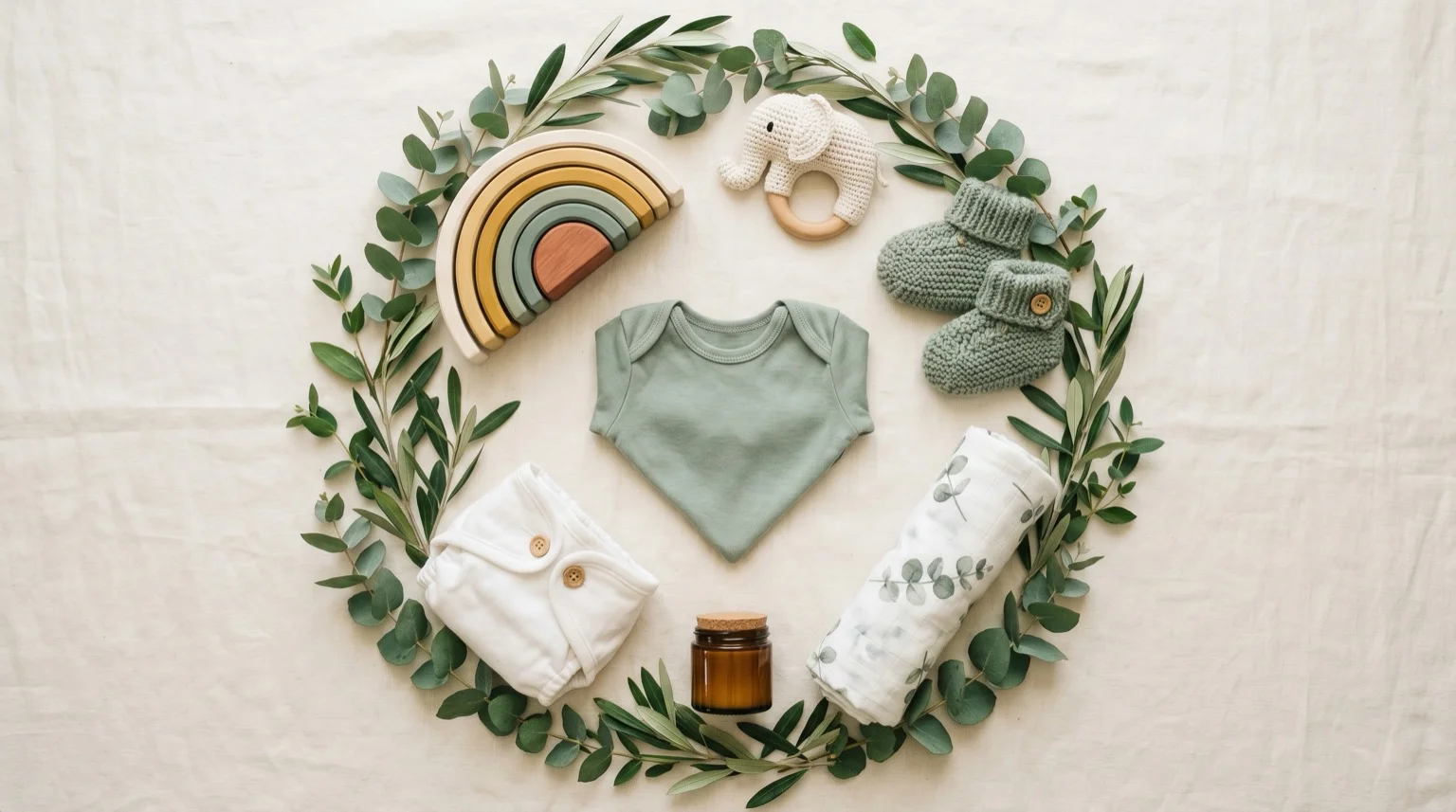
When you're expecting a baby — or looking for a gift for someone who is — the word "eco-friendly" appears everywhere, but it doesn't always mean anything concrete. What actually makes a newborn product truly ecological? And how do you tell a certified product from a greenwashed one before you put it on a registry? This guide answers both questions: first the certifications that matter and how to verify them yourself, then products by category.
Why Choose Eco Products for a Newborn
A newborn's skin is five to seven times thinner than adult skin: it absorbs chemicals, dyes and formaldehyde at a rate the adult body simply doesn't experience. Cheap synthetic fibres and the chemical treatments used on conventional fabrics — softeners, anti-crease agents, antibacterial finishes — come into direct contact with delicate skin and mucous membranes. This isn't scaremongering: it's physiology. Choosing certified natural materials measurably reduces that exposure.
The environmental argument is equally concrete: the textile industry is responsible for around 10% of global CO₂ emissions, and newborns get through enormous quantities of fabric (they grow fast — a bodysuit lasts a matter of weeks). The single biggest lever is buying fewer, better-certified pieces and keeping them in circulation afterwards — handed down, resold or donated — rather than buying a bigger pile of cheaper ones.
The Certifications That Actually Matter
Without verifiable certifications, "eco" is just marketing. Here are the labels worth paying attention to:
- GOTS (Global Organic Textile Standard) — the gold-standard certification for textiles made from cotton, linen or wool: it guarantees the organic origin of the fibres AND production processes free from harmful chemicals. Applies to clothing, sheets and towels. A compliant label carries the label grade (“Organic” for 95% or more certified organic fibre, “Made with x% organic materials” for 70–94%), a reference to the certification body and the certification number of the certified entity — and you can look that number up in the GOTS public database.
- OEKO-TEX STANDARD 100 — verifies the absence of harmful substances in the finished product (even if the fibres are not organic). It is the most widespread and most accessible certification to find, even at lower price points. Every label carries a number you can verify in OEKO-TEX Label Check, which also lists withdrawn certificates.
- FSC (Forest Stewardship Council) — for all wood: cribs, bassinets, toys, changing tables. Guarantees that the wood comes from responsibly managed forests.
- ASTM F963 and the Children's Product Certificate — not an environmental label, but the floor every toy has to clear in the US. Section 106 of the Consumer Product Safety Improvement Act made ASTM F963 a mandatory consumer product safety standard for children's toys, and toys manufactured after 20 April 2024 must meet the ASTM F963-23 revision. The manufacturer or importer issues a Children's Product Certificate, and the same law caps lead at 100 ppm in an accessible component, 90 ppm in paint and surface coatings, and eight named phthalates at 0.1%.
- COSMOS Organic / NaTrue / ECOCERT — for cosmetics and cleaning products: guarantees natural or organic ingredients and sustainable production processes.
Organic Cotton Clothing and Textiles
Layette is the category where the eco choice has the greatest impact: bodysuits, sleepers, pyjamas, sheets and towels are in constant contact with a newborn's skin. Look for the wording 100% organic cotton, GOTS certified or at least OEKO-TEX STANDARD 100.
Rather than a list of brands — brands change hands and certificates expire — buy the label, not the name. Four checks take a minute each:
- Read the fibre content. Under the Textile Fiber Products Identification Act, the FTC requires every garment label to list the generic fibre names and percentages by weight in descending order, plus the country of origin and the maker's name or RN number. “Cotton blend” with no percentages is not a compliant label.
- Check the GOTS grade. “Organic” means 95% or more certified organic fibre; “Made with x% organic materials” means 70–94%. Anything below that cannot carry a GOTS label at all.
- Look up the number. A GOTS label names its certification body and the certification number; an OEKO-TEX label carries a label number. Both are searchable in the public databases linked above. No number, no certification.
- Sleepwear is regulated separately. Children's sleepwear in sizes 0–6X (16 CFR 1615) and 7–14 (16 CFR 1616) must either pass CPSC flame-resistance testing or meet the tight-fitting garment measurements that exempt it from that testing. That exemption is why plain snug cotton pyjamas are sold with a tag telling you the garment is not flame resistant and should fit snugly: they are compliant by fit, not by treatment.
For bed textiles (sheets, blankets, bumpers), look for bamboo + organic cotton blends: they regulate temperature better than pure cotton, are naturally antibacterial and ultra-soft. Search for organic baby sheets on Amazon
Eco Toys: Wood, Natural Rubber and Organic Soft Toys
Plastic dominates the toy industry, but alternatives exist and are often more beautiful and longer-lasting:
- FSC-certified wood — rattles, teethers, first puzzles, building blocks. Wood is warm to the touch, heavy enough to feel "real" to a baby, and virtually indestructible. Paints should be water-based or natural oil finishes, not synthetic lacquers.
- Natural rubber from the Hevea tree — teethers and figurines in 100% natural rubber, widely sold in the US. A safe alternative to BPA-free plastic, often coloured with natural pigments. Natural rubber is a latex material, so it is worth knowing if there is a latex allergy in the family.
- Organic cotton soft toys — stuffed with kapok (a plant fibre) or organic cotton instead of polyester. Soft toys carry a fibre-content label like any other textile: read it, and treat “natural” with no fibre percentages and no certification number as a decorative claim.
Whatever the material, the age grading on the box is doing safety work, not marketing work. The CPSC small parts ban (16 CFR 1501) applies to products intended for children under 3, and a “small part” is anything that fits whole into a test cylinder approximating the throat of a child under three. A toy labelled 3+ has not passed that test — it has been excluded from it.
Search for FSC wooden toys for newborns on Amazon
Cloth Diapers: The Biggest Impact
The volume here is the whole argument. The EPA's product-specific waste data puts disposable diapers at 4.1 million tons generated in 2018, about 1.4% of all municipal solid waste, of which 3.3 million tons went to landfill. Modern cloth diapers are nothing like the pinned prefolds of thirty years ago: all-in-ones and pocket diapers close with velcro or snaps and are practically indistinguishable in use from disposables.
To get started without stress, many families adopt a hybrid approach: cloth at home and overnight, disposables when out or travelling. Even using cloth half the time halves your household share.
Judge a cloth system on the layer that touches the skin, not the printed outer shell: look for an organic cotton, bamboo or hemp inner with a GOTS or OEKO-TEX number you can verify, and check the sizing model — one-size diapers that adjust with snaps cost more up front but cover birth to potty training, while sized systems mean buying twice. Search for organic cloth diapers on Amazon
Natural Cosmetics for Newborns
Shampoo, massage oils, diaper creams: a newborn's skin doesn't need many products — but the ones it does use need to be clean. Look for the Cosmos Organic or NaTrue certification, which guarantees the absence of aggressive synthetic ingredients (synthetic fragrances, SLS, parabens, silicones, mineral oils).
Two things separate a certified product from a “natural” one on the shelf:
- A named certifier on the pack. COSMOS Organic and NaTrue are audited schemes with published criteria. “Plant-based”, “dermatologically tested” and “pure” are not — they are not defined by anyone and no one checks them.
- The ingredient list, read backwards. Turn the bottle over and look at what comes after the first three or four ingredients: added fragrance (listed as “fragrance” or “parfum”), SLS, and mineral oil are the ones worth avoiding on newborn skin, and a short list is a good sign in itself. A newborn needs very few products at all.
Cribs, Changing Tables and Nursery Furniture
Furniture is where the safety floor matters most, because it is also the category people are most tempted to buy or accept second-hand. Full-size cribs sold in the US must comply with 16 CFR part 1219, which incorporates the ASTM F1169 standard — the rule that ended drop-side cribs in the US market in 2011. A hand-me-down crib older than that does not meet the current standard, however good the wood is.
What to look for on a new one:
- FSC-certified solid wood rather than particleboard, and water-based or natural-oil finishes rather than synthetic lacquers.
- Low-emission panels where engineered wood is used at all — the relevant claim is formaldehyde emissions, and a manufacturer that meets a limit will say which one.
- A convertible frame that becomes a toddler bed. It is the single change that most extends the life of the piece, which is the most ecological thing a crib can do.
How to Add Eco Gifts to Your Baby Registry
The practical challenge with eco-friendly gifts is that they often cost a little more — not hugely, but enough that it makes sense to put them on a gift list. The natural solution is a shared baby registry: add the brands and products you have chosen, with a direct link, and the people who care about you can reserve exactly what you want. No duplicates, no "I didn't know what to get", no conventional product standing in for the organic one you carefully selected.
You can add products from any website — Amazon, Target, brand websites directly, natural-products retailers, Etsy — with a single link for each item. For more expensive items (a crib, a full set of cloth diapers) you can use the group gift feature: several people contribute to the same item.
Frequently Asked Questions
Which certifications should you look for in an eco-friendly gift for a newborn?
The main ones are GOTS for organic cotton textiles, OEKO-TEX STANDARD 100 for the absence of harmful substances in the finished product, FSC for the wood used in cribs and toys, and COSMOS Organic or NaTrue for cosmetics. Safety is a separate matter: in the US, ASTM F963 is the mandatory toy safety standard and the manufacturer must issue a Children's Product Certificate.
Why choose eco-friendly products for a newborn instead of conventional ones?
A newborn's skin is five to seven times thinner than adult skin and absorbs chemicals, dyes and formaldehyde from conventional fabrics much faster. Certified natural materials reduce that exposure. There's an environmental angle too: the textile industry is responsible for around 10% of global CO₂ emissions.
How do I check that an “organic cotton” claim on baby clothes is genuine?
A real GOTS label carries three things: the label grade (“Organic” for 95% or more certified organic fibre, “Made with x% organic materials” for 70–94%), a reference to the certification body, and the certification number of the certified entity. You can look that number up in the GOTS public database. An OEKO-TEX label number can be checked the same way in OEKO-TEX Label Check. A tag that just says “organic” with no certifier and no number behind it is marketing, not certification.
Are reusable diapers really more eco-friendly?
The volume is real: the EPA counted 4.1 million tons of disposable diapers generated in the US in 2018, about 1.4% of all municipal solid waste, of which 3.3 million tons were landfilled. Modern reusable diapers use all-in-one systems that are practically indistinguishable in use from disposables; even using them half the time halves your household share.
Are wooden toys safer than plastic ones?
FSC-certified wooden toys come from responsibly managed forests and use water-based paints or natural oil finishes instead of synthetic lacquers. Safety, though, is a separate question from material: any toy sold in the US has to meet ASTM F963 and the CPSIA limits on lead (100 ppm in an accessible component, 90 ppm in paint) and on eight phthalates (0.1%).
How can I add eco-friendly gifts to my baby registry?
You can add products from any website — Amazon, Target, brand websites directly, natural-products retailers, Etsy — with a single link for each item. For more expensive items, like a crib or a full set of cloth diapers, you can use the group gift feature so several people contribute to the same item.